"No man can become rich without himself enriching others"
Andrew Carnegie


Friday, January 6, 2012

4 Stocks Ready to Go

4 Stocks Near A Breakout

Investopedia
The stock market is in an interesting position as we kick off 2012. The market started the year by closing sharply higher despite giving back some intraday gains. After some early weakness the following day, the stock market... (read more).

Medium Term Growth Portfolio

Short Term Growth Portfolio

Free Up Trend Stock Picks: ROST - SCSS - PIR

Ross Stores Inc. (ROST).- Price: US$ 50.42 (Var: +5.88%). Volume: 5.03 Millions of shares (daily MA: 1.88M). New high with good volume.

Select Comfort Corp. (SCSS).- Price: US$ 23.38 (Var: +4.98%). Volume: 1.21 Millions of shares (daily MA: 974K). Good advance.

Pier 1 Imports Inc. (PIR).- Price: US$ 14.76 (Var: +4.90%). Volume: 4.82 Millions of shares (daily MA: 1.93M). Good advance.

Free Down Trend Stock Picks: DB - CS - PHG

Deutsche Bank AG. (DB).- Price: US$ 36.230 (Var: - 6.21%). Volume: 4.71 Millions of shares (daily MA: 2.67M). Important fall with high volume.

Credit Suisse Group (CS).- Price: US$ 23.08 (Var: -5.37%). Volume: 2.83 Millions of shares (daily MA: 2.22M). Good gap down.

Koninklijke Philips Elec. (PHG).- Price: US$ 20.06 (Var: -3.88%). Volume: 1.88 Millions of shares (daily MA: 1.42M).

Why You Should Run When Wall Street Says Buy

By Simon Maierhofer | ETFguide

A quick scan of analysts' 2012 forecasts shows that most of Wall Street expects stocks to rise in 2012. Before you get excited, consider this:
'Five Wall Street heavyweights say it's time for individual investors to shun the perceived safety of bonds and get over their fear of the U.S. stock market so they can take advantage of what they predict will be a third straight year of solid gains for stocks in 2011.'
Before you go out and buy stocks, beware that you just read the 2011 outlook printed on the front page of USA Today's December 17, 2010 edition. USA Today wasn't the only one distributing Wall Street's Kool Aid.
'Outlook 2011 - 10 strategists see the S&P 500 finishing next year at 1,373' - Barrons, December 18, 2010
'Long way from dog days: 2011 might see record Dow' - AP, December 17, 2011

'Greenspan says U.S. economy is gaining momentum, may expend 3.5% next year' - Bloomberg, December 17, 2010
2011 Casualty Report
Wall Street's bullish outlook paid off for the first 34 trading days of 2011, but starting in mid-February the major U.S. indexes a la Dow Jones (DJI: ^DJI - News), S&P 500 (SNP: ^GSPC -News), Nasdaq (Nasdaq: ^IXIC - News) and Russell 2000 (NYSEArca: IWM - News) suffered a series of set backs.
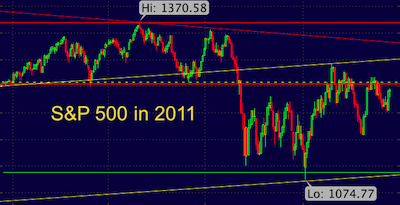
As the chart of the S&P 500 below shows, there was one major high and one major low along with a number of minor highs and lows within a general trading range.
                                
What was Wall Street's advice right before the May high and the October low? Buckle up, enjoy the ride and get ready to make a brand new New Year's resolution.
Guilty on All Counts
The S&P 500 topped on May 2 at 1,370.58. Ironically that was the same day Osama Bin Laden's death hit the wire (so much for news driving the market). Here are some headlines found right before the May high:
'World revs up U.S. profits' - Wall Street Journal
'GE CEO Immelt says global economy is improving' - AP
'The S&P 500 breaks out' - Yahoo Breakout
'The Dow's going to 20,000' - Yahoo
'Sales Growth the big surprise on Wall Street' - AP
'Buffett says odds of another U.S. banking crisis low' - AP
Quite to the contrary, the May 1 ETF Profit Strategy Newsletter recommended to go short at 1,369 with a tight stop-loss. This trade was in line with the outlook provided in the April 3 ETF Profit Strategy update: 'In terms of resistance levels, the 1,369 - 1,382 range is a strong candidate for a reversal of potentially historic proportions.'
Over the next few weeks, the newsletter recommended to lock in profits a couple of times, but most importantly reaffirmed its recommendation to go short before the summer meltdown occurred.
The Perfect SeeSaw
From July 7 to October 4 the S&P lost 20%. On September 23, the ETF Profit Strategy Newsletter foretold that: 'From its May high at 1,370 to its eventual low, the S&P will likely have lost about 300 points (22%). This kind of move validates a counter trend rally. The plan is to square short positions and buy long positions around 1,088. The rally, once underway, will probably re-inspire a certain degree of confidence into the market before it runs out of steam. The most likely target for this rally is S&P 1,266 - 1,282.'
By now you probably guessed that Wall Street's take on the market was different. Here's a brief sample of headlines:
'Think the economy is bad? You haven't seen anything' - CNBC, October 3
'S&P enters bear market territory' - Reuters, October 4
'S&P falls to the bears' - TheStreet, October 4
What effect did Wall Street's guidance and the media's cheerleading have? On October 2, two days before the onset of a massive 20%, 18 day trading rally, the Associated Press reported that: 'Wild market ride is driving people out of stocks.'
Thanks to the lethal Wall Street/media combo, many investors sold at the worst time, again.
Asset-Overreaching Incompetence
Wall Street had the same rotten timing when it came to gold (NYSEArca: GLD - News) and silver (NYSEArca: SLV - News).
Silver spiked to nearly $50 on April 28. On April 27, the Wall Street Journal reported that: 'Silver rush spreads to stock market. Investors have turned to precious metals amid worries about inflation and the weakness in the U.S dollar. The metals are increasingly considered attractive as a permanent store of value that doesn't diminish like paper currencies.'
The April 25 ETF Profit Strategy update pointed out silver's gap up open and warned that: 'The gap up open may have been an exhaustion gap and cautions that a historic reversal may have occurred.'
The Next Profit Opportunity
The October 4 low proved to be a great buying opportunity. Since the S&P reached my target range of 1,250 - 1,300 however, the performance has become stale. Via the November 30 ETF Profit Strategy Newsletter I assumed that: 'Based on seasonality and today's volume it appears that higher prices are likely. I would like to see a slow grind within the 1,226 - 1,xxx (reserved for subscribers) range. This would suggest a virtually untradeable December followed by another great opportunity.'
This 'great opportunity' is not here quite yet, but a quick glance at VIX (NYSEArca: VXX - News) shows that volatility creates a double bottom in December/January, which usually coincides with a January top of some sort for stocks.
The ETF Profit Strategy Newsletter identifies the up side target of this rally along with an easy to understand short, mid and long-term forecast.

Tips & News

Unemployment Rate Falls As Economy Adds 200K Jobs


Jobs hopes buoy stocks, debt outlook dents 
Europe's debt crisis: 'No clear end in sight' 
Euro zone's economy slumps at year-end; business climate warms
Hungary Pledges Compromise on IMF Loan
New iPhone Doubles Data Consumption 
Barnes & Noble Seeks Next Chapter
LG Elec Joins Google to Roll Out Google TV
MF Global Inquiry Turns to Its Primary Regulator
Oil rises above $102 ahead of key US jobs report

Euro Drops to 15-Month Low Against Dollar

By Keith Jenkins and Kristine Aquino 
Bloomberg

The euro headed for a fifth weekly loss against the dollar as a European report showed confidence in the economic outlook fell to a two-year low, making it harder for the region’s leaders to contain the debt crisis.
The 17-nation currency was about 0.1 percent from the weakest in 11 years versus the yen as Spain and Italy prepare to sell debt next week after France’s borrowing costs rose at an auction yesterday. The dollar headed for weekly gains versus the yen before a U.S. report forecast to show employers added the most jobs in three months in December. Hungary’s forint strengthened for a second day against the euro.
“There’s still negative sentiment surrounding the euro, and it’s likely to weaken further,” said Lee Hardman, a currency strategist at Bank of Tokyo-Mitsubishi UFJ Ltd. in London. “Today’s data will likely confirm declining business and consumer confidence. The market has almost fully priced in a recession in Europe. The question is how deep and how prolonged that will be.”
The euro was little changed at $1.2802 at 10:04 a.m. in London having fallen 1.2 percent this week, the longest stretch of declines since February 2010. It earlier fell to $1.2764, the lowest since September 2010. The single currency gained 0.1 percent to 98.73 yen after falling to 98.48 yen yesterday, the weakest since December 2000. The dollar was unchanged at 77.12 yen, having risen 0.3 percent this week.

‘Weaker Euro’

An index of executive and consumer sentiment in the euro area declined to 93.3 in December from a revised 93.8 in the previous month, the European Commission said today. The unemployment rateheld at 10.3 percent in November, a separate report showed.
“There’s not a huge amount of reasons to be wanting to own the euro at the moment,” said Chris Weston, an institutional trader at IG Markets Ltd. in Melbourne. “The fundamentals point to a weaker euro.”
The euro fell yesterday after France sold 10-year bonds at an average yield of 3.29 percent, compared with 3.18 percent at a sale on Dec. 1. The bid-to-cover ratio, or the number of bids received for each unit of debt sold, fell to 1.64 from 3.05. France’s credit outlook was lowered byFitch Ratings on Dec. 16.
Spain is scheduled to sell bonds maturing in 2015 and 2016 on Jan. 12. Italy will auction debt the following day.

Merkel, Sarkozy

German Chancellor Angela Merkel will meet French President Nicolas Sarkozy on Jan. 9 in Berlin to talk about increasing fiscal coordination among euro area states before the European Union leaders’ summit at the end of the month.
Japanese Finance Minister Jun Azumi told reporters in Tokyo today he understands the weakening of the euro against the yen will have a significant impact on companies that export their goods to the region. Japan sold the yen three times last year as its strength threatened to derail an export-led recovery.
The dollar rose against the euro and yen this week before a report forecast to show the U.S. added jobs in December, adding to signs the world’s largest economy is recovering.
“The news coming from the U.S. has been OK,” said Derek Mumford, a Sydney-based director at Rochford Capital, a currency-risk management company. “We’re seeing just generally some U.S. dollar strength, which is mainly reflected in the euro.”
U.S. Jobs
U.S. employers hired 155,000 workers last month, compared with a gain of 120,000 in November, according to a Bloomberg survey before today’s Labor Department report. That would be the most since September. The jobless rate (USURTOT) rose to 8.7 percent from 8.6 percent in the same period, a separate survey showed. U.S. companies added 325,000 workers in December, the most in records going back to 2001, ADP Employer Services said yesterday.
IntercontinentalExchange Inc.’s Dollar Index (DXY), which tracks the greenback against the currencies of six major U.S. trading partners, was little changed today to 80.835 after rising to 81.062, the highest since Jan. 11, 2011.
The forint pared its weekly decline as Hungary’s Prime Minister Viktor Orban met central bank President Andras Simor amid a dispute about the bank’s independence that threatens the country’s bailout.
Orban met with Simor and Economy Minister Gyorgy Matolcsy, the premier told reporters in Budapest today. Hungary needs a “quick” deal on aid with the International Monetary Fund and the European Union and is ready to discuss the conditions, Tamas Fellegi, the minister assigned to lead the aid talks, told reporters yesterday.
“Early forint action shows that markets are happy with this” meeting, Simon Quijano-Evans, an economist at ING Groep NV (INGA) in London, wrote in a research report today. “It would be great to say that after 18 months of noise, we are seeing light at the end of the tunnel. All the more so since Orban and Simor are apparently meeting now.”
Hungary’s currency gained 0.6 percent to 317 per euro, trimming this week’s decline to 0.6 percent.
To contact the reporters on this story: Kristine Aquino in Singapore at kaquino1@bloomberg.net; Keith Jenkins in London at kjenkins3@bloomberg.net
To contact the editor responsible for this story: Daniel Tilles at dtilles@bloomberg.net

Thursday, January 5, 2012

Stock Market Today

5 Dumb Things Investors Do With Their Money

Medium Term Growth Portfolio

Short Term Growth Portfolio

Three Candidates for Longs: ROST -SCSS - PIR

Ross Stores Inc. (ROST).- Price: US$ 50.42 (Var: +5.88%). Volume: 5.03 Millions of shares (daily MA: 1.88M). New high with good volume.

Select Comfort Corp. (SCSS).- Price: US$ 23.38 (Var: +4.98%). Volume: 1.21 Millions of shares (daily MA: 974K). Good advance.

Pier 1 Imports Inc. (PIR).- Price: US$ 14.76 (Var: +4.90%). Volume: 4.82 Millions of shares (daily MA: 1.93M). Good advance.

Three Candidates for Shorts: Deutsche Bank - Credit Suisse and PHG

Deutsche Bank AG. (DB).- Price: US$ 36.230 (Var: - 6.21%). Volume: 4.71 Millions of shares (daily MA: 2.67M). Important fall with high volume.

Credit Suisse Group (CS).- Price: US$ 23.08 (Var: -5.37%). Volume: 2.83 Millions of shares (daily MA: 2.22M). Good gap down.

Koninklijke Philips Elec. (PHG).- Price: US$ 20.06 (Var: -3.88%). Volume: 1.88 Millions of shares (daily MA: 1.42M).

Will China Come in for a Hard or Soft Landing?

By Gregg Wolper | Morningstar 

Many issues have been causing concern for global investors over the past few months. Front and center is the never-ending European debt crisis. The situation in Greece is not improving, and lately investors have been dumping the bonds of even those countries previously considered to be sheltered from the storm, such as France. In this climate, China's slowing pace of growth has not been grabbing as many headlines. But it remains a major issue for managers trying to position their portfolios.
Even managers who don't focus exclusively on Asia say they must take into account their outlook for China's economy because of the impact that country's governmental policies and corporate actions have on stocks, bonds, and currencies around the world. No manager can think about the major resource companies in Brazil, Australia, or Canada, for example, without at least trying to gauge where Chinese demand for those commodities is heading.
In general, managers say that concerns about a "hard landing"--meaning that the Chinese economy will head south quickly and suffer a serious slowdown or even a recession--are overblown. Many, though, do expect China's economy to continue slowing, partly due to government actions, and they do worry about the country's financials sector in particular.
"In China, we expect growth will slow, but by how much remains the question," Artio International Equity(BJBIX) managers Rudolph-Riad Younes and Richard Pell wrote to shareholders recently. "We do not see the hard landing expected by the markets ... in our view, China has ample latitude from both a monetary and fiscal perspective to deal with a slowing global economy."
Still a Big Deal
China is the largest emerging market when measured by market capitalization. At the end of November 2011, it made up 17.7% of the portfolio of Vanguard Emerging Markets Stock Index(VEIEX), which tracks the MSCI Emerging Markets Index. China's share had been a bit larger one year earlier, at 18.6% of assets, but the weaker performance of its stock market compared with some others in the index brought down that figure.
That doesn't make China any less important, though. "We believe that demand from China will continue to heavily influence emerging market performance, and that a hard landing is less likely now that China's growth rate has moderated to a more sustainable level," wrote Lazard Asset Management, which has extensive emerging-markets investments, in its 2011 Fourth Quarter Outlook.
Not Worry-Free
Some managers who doubt the likelihood of a sharp fall in China's economy nonetheless have concerns about its financials sector. For example, the managers of Matthews Pacific Tiger(MAPTX) reported recently that they have an underweighting in Chinese financials partly because of uncertainty created by the growing amount of activity in the lightly regulated "gray loan" sector outside of the formal banking system.
Meanwhile, while they recognize the growth of what they call the "shadow banking" sector in China, the members of PIMCO's Asia-Pacific Portfolio Committee are less concerned that either that activity or rising property prices will have serious consequences for China. They cite the strong government responses to these issues, as well as other factors such as high levels of household saving.
Rajiv Jain of Virtus Foreign Opportunities(JVIAX), who is among the minority of managers who take more seriously the possibility of a hard landing, also worries about China's financials sector. He doesn't think highly of the managements or accounting practices of Chinese banks, and he fears that government attempts to rein in rising property prices could have negative effects on the country's banks.
Austin Forey of JPMorgan Emerging Markets Equity(JFAMX) agrees that China's banks are risky plays and that some observers doubt the accuracy of their financial reports. But he includes some in the portfolio because he feels they're attractive as franchises, have few problems with nonperforming loans, and are trading at cheap prices.
Something Wicked This Way Comes?
Domestic-fund manager Chris Davis, whose Davis New York Venture(NYVTX) and Selected American(SLADX) were hurt by scandal-plagued Sino-Forest (TRE) and other China-related holdings in 2011, still thinks global leaders will emerge from China over the long term. He maintains positions in some Hong Kong-listed firms with long operating histories, such as China Merchants Holdings. Investors have to be ready for volatility, though. Davis has said, "anybody would be crazy to think that there would not be wicked corrections from time to time."
Gregg Wolper does not own shares in any of the securities mentioned above.

Tips & News

Jobless Claims on Tap
Debt, Banking Woes Hit European Markets
Kodak Teeters on the Brink
UPDATE 1-China denounces EU airline carbon law, seeks talks
Giant tuna fetches record $736,000
Boeing Said to Close Kansas Plant Amid US
French Borrowing Costs Nudge Upward in First Bond Sale of New Year
Rick Santorum's tax plan
China extends Iran oil import cut as sanctions mount
Fiat gets another 5 percent of Chrysler
World stocks mostly lower on eurozone worries
China heavy-lift chopper receives certification
Oil hovers below $103 amid mixed US supply signs
Stirring up a fight, Obama names consumer watchdog 
Rebalancing? Don't Overlook Sector, Style Exposure
Report: Kodak may file for bankruptcy 
Oil steady as dollar gains cap rise on Iran tension
Costco key revenue figure rises 7 pct in December
GOP 2012 budget cut promises: What they (wouldn't) cut


Stocks Decline as Euro Weakens on Concern Over Debt Crisis

By Stephen Kirkland and Lynn Thomasson
Bloomberg

Stocks (MXWD) and the euro declined on concern Europe will struggle to contain the debt crisis. Hungarian shares tumbled and the forint declined as borrowing costs climbed at an auction today.
The Stoxx Europe 600 Index (SXXP) lost 0.8 percent at 10:45 a.m. in London as UniCredit SpA, Italy’s biggest bank, tumbled for a second day. Standard & Poor’s 500 Index futures slid 0.8 percent. French 10-year bond yields were little changed after a government debt sale. The euro weakened 0.8 percent to $1.2845. Hungary’s forint sank 0.4 percent to 321.61 versus the euro.
Greek Prime Minister Lucas Papademos said yesterday deeper cuts in incomes and an agreement on international aid are the only way for the country to avert economic collapse and a “disorderly default.” Francesold 10-year bonds at an average yield of 3.29 percent, up from 3.18 percent in December, and the yield on Hungary’s one-year bills climbed to the highest level since 2009. The U.S. service industry probably grew last month and jobless claims fell last week, economists said before reports today.
“We expect the euro-zone recession to deepen early in the year and for European financial-market pressures to remain intense in the next few months,” said Dominic Wilson, chief market economist at Goldman Sachs Group Inc. in Frankfurt.
The decline in the Stoxx 600 extended yesterday’s 0.6 percent drop. UniCredit slid 8.9 percent to the lowest level since 1992 after yesterday plunging 15 percent on plans to sell shares in a rights offer at a 43 percent discount.

Banks Decline

Societe Generale SA retreated 4.6 percent as the French bank said it plans to cut about 1,580 jobs at its corporate and investment banking unit. Banco Comercial Portugues SA and Banco Espirito Santo SA lost more than 6 percent in Lisbon.
The decline in S&P 500 futures indicated the U.S. equities gauge will drop for the first time this year. The Institute for Supply Management’s non-manufacturing index, due for release at 10 a.m. New York time, rose to 53 in December from 52 the previous month, according to a Bloomberg survey of economists. Fifty is the dividing line between expansion and contraction in the services gauge.
A separate release may show the number of applications for jobless benefits fell last week. The data comes before tomorrow’s payrolls report from the Labor Department, which is forecast to show the U.S. economy generated 150,000 jobs last month, according to an economist survey.

Aid Talks

Hungary’s BUX Index (BUX) fell 3 percent, taking its three-day decline to 5.7 percent. The average yield on Hungarian 12-month bills jumped to 9.96 percent from 7.91 percent at the last sale of the same maturity on Dec. 22, according to auction results on the state debt management agency’s Bloomberg page.
The yield on France’s 10-year bond was little changed at 3.31 percent. The extra yield (.FRANGER) investors demand to hold French 10-year debt instead of benchmark German bunds rose two basis points to 141 basis points.
The Dollar Index (DXY), which tracks the U.S. currency against those of six trading partners, climbed 0.6 percent. The euro slid 0.7 percent against the yen, approaching an 11-year low, and depreciated 0.3 percent versus the pound.
Oil in New York fell 0.8 percent to $102.42 a barrel, the first decline in three days.
To contact the reporters on this story: Stephen Kirkland in London atskirkland@bloomberg.net; Lynn Thomasson in Hong Kong atlthomasson@bloomberg.net