The data favored by the Status Quo interests are GDP (which rises when the government borrows and blows trillions of dollars), housing sales (still low compared to 2006, but better than 2011) and consumer confidence, which is hitting multi-year highs. Consumer confidence is a quasi-quantitative measure of the critical "animal spirits" that Keynesians look for to drive more borrowing and spending: if you feel wealthier for whatever reason, that confidence arouses your "animal spirits" to rush out and buy something, preferably a house and a car.
Those looking at fundamentals such as household income/debt and sales see more of a Mind Trick being played on the weak-minded. If you can convince me the economy is expanding and inflation is rising, I will be more likely to risk borrowing and spending more than I can afford. The "real" economy might be sputtering, but my belief in the "recovery" will support my confidence in the wisdom of leveraging more of my (shrinking) income into debt-based consumption.
This debt-based consumption (according to the Keynesian Cargo Cult) will spark so much "growth" that the expansion will become self-sustaining. Corporations will see the rise in sales and become confident enough to make capital investments and hire more workers, who will then spend their paychecks consuming more stuff, and so on.
So the task of the Status Quo shifts from actually expanding the economy to persuading us the economy is expanding. If the Mind Trick works, then maybe the unleashed "animal spirits" will actually spur real-economy growth.
It appears a certain number of buyers are convinced housing has bottomed, and this confidence (misplaced or not, no one yet knows) has persuaded them to buy real estate. This has indeed fueled a self-sustaining growth cycle in some areas, as people waiting for the bottom are jumping in, pushing prices higher and drawing in more converts.
On the other hand, if household incomes continue weakening, then the confidence of all those real estate investors in rising rents and 100% occupancy might not align with reality as well as they anticipate.
All debt and consumption is based on income. Consider these charts:
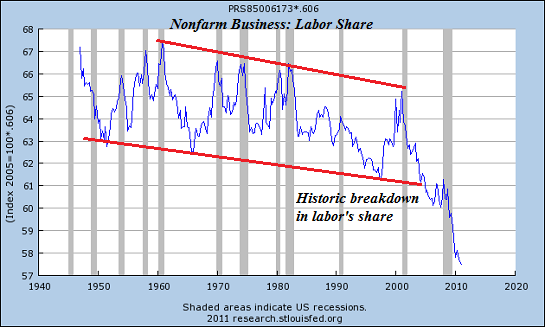
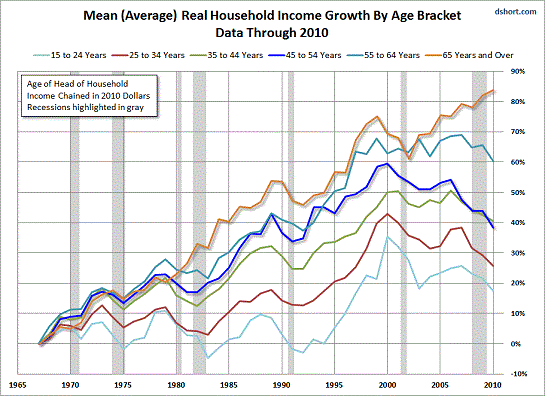
Notice that the only age bracket with rising incomes is the 65 and over cohort; everyone younger than 65 has seen their income slashed.
... Continue to read.

No comments:
Post a Comment