"No man can become rich without himself enriching others"
Andrew Carnegie


Showing posts with label best stock. Show all posts

Wednesday, August 21, 2013

Avoid the Emerging Markets Storm

HK Central QRC Luk Hoi Tong Bldg n Theatre Lan...
HK Central QRC Luk Hoi Tong Bldg n Theatre Lane Hang Seng Index (Photo credit: Wikipedia)
By Rude Awakening

Baltimore, Aug.21, best stock .- The broad market just posted its first four-day losing streak of the year. But you should continue to concentrate on U.S. stocks to help fuel gains in your portfolio.

Why?

Because despite recent market weakness stateside, the rest of the world's performance just isn't up to snuff right now—especially emerging markets.

Take a look:


And the chart illustrates just a couple of examples. MarketWatch notes that today alone even the major Asian markets tumbled alongside the once-revered emerging market leaders. Japan's Nikkei dropped 2.6%, South Korea's Kospi lost 1.6% and Australia's S&P/ASX 200 gave up 0.7%, and Hong Kong's Hang Seng Index shed 2.2%...

"The eye of the storm is directly above emerging markets now, two years after it hovered over Europe and four years after it hit the U.S.," Stephen Jen, co-founder of hedge fund SLJ Macro Partners LLP in London and former head of foreign-exchange strategy at Morgan Stanley told Bloomberg. "This could be serious for Asia."

As a result, investors are favoring U.S. stocks over emerging markets by the most ever right now. "Almost $95 billion was poured into exchange-traded funds of American shares this year, while developing-nation ETFs saw withdrawals of $8.4 billion," Bloomberg notes. That's huge…

I know this week isn't looking very promising so far (not even here in ole' USA). In fact, it's been downright crappy. Everything—and I mean everything—closed lower yesterday. Bonds, gold, and stocks. All of them fell Monday.

But it's August. Trading volume is incredibly low right now. While the short-term trend for the broad market is lower, it's not yet flirting with disaster. Conditions can change quickly. We have to react—not anticipate.

In the meantime, except for a select few opportunities, you should not try to bottom-pick emerging markets. It will only lead to pain and suffering for your portfolio…

.
Enhanced by Zemanta

Tuesday, August 20, 2013

Death Blow Dealt to the Bulls?

Monday, Monday...
Monday, Monday... (Photo credit: practicalowl)
Monday's price action was the coup de grace for those who expected the market to break to new highs again this summer


There was little in the way of news on which to focus, but a new probe of banks and their foreign policies led to selling in the financial sector. Other interest rate sensitive sectors like housing, construction and utilities underperformed.
At Monday’s close, the Dow Jones Industrial Average was off 71 points at 15,011, the S&P 500 fell 10 points to 1,646, and the Nasdaq lost 14 points at 3,589. The NYSE traded 640 million shares and the Nasdaq crossed 342 million. Decliners outpaced advancers on the Big Board by 4.4-to-1 and on the Nasdaq by 2.3-to-1.
Chart Key
The S&P 500 continued to fall Monday, and following the close, it is 64 points, or 3.7%, from its all-time time high made just 12 sessions ago. Those who were bullish at the top must be very frustrated since Monday’s clear penetration of the index’s 50-day moving average qualifies the August high as a “false breakout.”
And Monday’s drop also confirmed that the near-term trend is down and the intermediate-term trend is likely to be down since the 50-day moving average is generally considered to be an inflection point.
Conclusion: Monday’s price action is the coup de grace for those who expected the market to recover and break to new highs again this summer. The 20/20 nature of hindsight reveals that investors had numerous opportunities to be skeptical of the August “breakout.”
Several times, I’ve mentioned the lack of breadth, an overbought McClellan oscillator, the unlikelihood that small caps would lead to a solid advance, etc.
The downside targets of the recent breakdown were outlined in Friday’s Daily Market Outlook: “S&P 500 1,642, then 1,573 (June closing low); Dow 14,660 (June closing low); and Nasdaq 3,320 (June closing low) after penetrating its 50-day moving average at 3,533. In other words, look for a 3%-7% decline with the high-tech and small- and mid-cap stocks hurt the most. It is time for defensive strategies since a pullback of this extent could be followed by a period of consolidation that may last for several months.”
Other technicians with high credentials, like Jeffrey Saut of Raymond James, expect a full 10% correction and look for a downside target of 1,560 to 1,530 on the S&P 500.
Today, however, with many of our internal indicators oversold (McClellan oscillator, MACD, etc.), I look for a weak bounce followed by a resumption of an intermediate correction. Thus, traders should sell into rallies.
...
Enhanced by Zemanta

Short the Market If This Happens

Spy vs. Spy
Spy vs. Spy (Photo credit: tr.robinson)
By StreetAuthority


New York, Aug.20, top stocks .- By some measures, stocks just suffered their worst week in 2013. Despite that setback, the S&P 500 is less than 3.2% from its all-time high. Until prices fall further, the weight of the evidence shows stocks are still in a long-term uptrend.
SPY Nears Support
SPDR S&P 500 (NYSE: SPY) fell for the second week in a row, losing 2.06% last week. Other majormarket indexes were also down as traders reacted to news that was generally considered to be negative. Among the most important news stories was that a number of companies, including Cisco (Nasdaq:CSCO) and Wal-Mart (NYSE: WMT), lowered their outlook for the rest of the year.
Even good news was bad news to traders last week. Retail sales exceeded expectations, and the number of initial unemployment claims fell to a six-year low.
The problem with good news is that the Federal Reserve has said they will taper their buying and eventually stop purchasing $85 billion worth of long-term bonds every month when unemployment declines sufficiently. Traders are concerned that the market could fall if the Fedstops buying long-term bonds.
Continued good news about the economy could be the cause of a stock market decline.
For now, SPY seems to be near a level where it should find support. The chart below shows a small head-and-shoulders pattern. The "S" on the left side is the first shoulder in the pattern. This forms when prices pull back after trending higher. The "H," or head, is the new high reached after the initial pullback. The "S" on the right is the second shoulder, which forms after a rally fails to reach a new high. The pattern could be labeled differently, but the general idea is the same for any type of topping pattern.
Almost all chart patterns use the idea of symmetry to find price targets. The eventual breakout is expected to be equal to the size of the pattern. In this case, the distance between the bottoms of the shoulders and the top of the head is equal to about $3.50. This value is subtracted from the breakout point and a target of $164 is drawn on the chart above.
The next chart shows that a similar target can be found with another technique.
After a price move, technical analysts look for a retracement. Markets never move straight up or down, and a retracement generally occurs after a significant increase or decrease in prices. At $163.35, SPY would retrace half of the move that pushed prices up from late June to early August.
A break below $163 would show that we exceeded a normal pullback and more downside should then be expected.
Good news for the economy will support growth in earnings, and that should push stock prices up in the longer term.
I still believe that the S&P 500 will reach 2,000 in the next 6-12 months. Long-term investors should not be concerned about the recent weakness in stock prices. Short-term traders should consider adding inverse ETFs like ProShares Short S&P 500 (NYSE: SH) to their portfolio if SPY falls below $163.
Gold Market Faces Less Selling Pressure
SPDR Gold Shares (NYSE: GLD) gained 4.51% last week. This gain came as SEC filings showed that large hedge funds reduced their positions in GLD during the second quarter.
John Paulson sold about 11.6 million shares, worth at least $1.3 billion. George Soros also sold his position in GLD, although it was much smaller than Paulson's at about 500,000 shares. These two investors were joined by a number of other investors who sold in the second quarter when the total outflow from GLD was $18.5 billion.
According to some reports, Paulson has not turned bearish on gold. He sold the ETF and boughtderivatives in gold.
The recent rally in GLD is in part due to the fact that so much selling has been completed. Selling pressure pushes prices down, and without that pressure, the price of gold seems to have stabilized.
GLD should continue to move higher over time. Large gains like we saw last week will probably alternate with large losses in the months ahead as gold tries to form a bottom that can provide support to long-term gains. Last week's move appears to be unsustainably rapid.
The chart above shows that the 26-week rate of change (ROC) of GLD is near its upper Bollinger Band. This is an indication that a short-term top is likely near.
Enhanced by Zemanta

Sunday, August 11, 2013

A Recovery Where You’d Least Expect It

English: Location of Dubai on the map of the U...
English: Location of Dubai on the map of the United Arab Emirates (Photo credit: Wikipedia)
By Daily Reckoning


Washington, Aug.12, best stock .- "I get calls weekly asking if I will sell my home. I finally stopped one to ask, 'Does anybody actually say yes?' And he said, 'Of course. Otherwise, why would we do this?'"

You might guess such cold-calling for houses is now happening in some hot U.S. market, like San Francisco. But no, this is actually going on in Dubai. This little city-state in the United Arab Emirates, on the Persian Gulf (or the Arabian Gulf, as it is called there), is enjoying a spectacular recovery. Yet there is still a long way to go. And there are ways to take advantage of the trend.

That was the key message of Peter Cooper, editor of ArabianMoney, from whom I quote at the start. Peter is English-born, but made his fortune in the Middle East and has been living in Dubai for 17 years. I've been to Dubai a few times, and I always enjoy the visit. It's a fascinating place, especially if you like modern architectural marvels.

Anyway, Peter was one among many who spoke at this year's Agora Financial Investment Symposium. It was another good conference, and I have come away with a few favorite ideas. This is one of them.

It was three years ago that Peter first made the case for Dubai. The economy then was "in tatters and investors' dreams in shreds. Remember the cartoons of heavily indebted Arabs begging for money? It was not so far from the truth. Dubai real estate had fallen 60% from the peak, and the stock market was a disaster area."

Those are, of course, the times to pay attention. It was during such time that Peter advised building positions in Dubai stocks for the inevitable recovery. This year, patience paid off. Dubai's stock market is up 63% for the year.

But it is still 75% off its high and a compelling bargain on the numbers.

"Let's have a look at some valuation metrics for the Dubai Financial Market courtesy of my old friends at Daman Securities, an excellent local broker if you need one," Peter said. He also recommends the National Bank of Abu Dhabi's brokerage arm NBAD Securities. It will establish offshore accounts for U.S. citizens without them visiting the UAE. Anyway, Daman Securities maps the Dubai market up against its regional peers and finds it to be the cheapest on a combination of earnings and book value per share.

Dubai has only recently finally been added to the world's main index of emerging markets. Before that, it was classified as a frontier market. "I always thought it was ridiculous to have Dubai in the same boat as Bangladesh and Cambodia," Peter said.

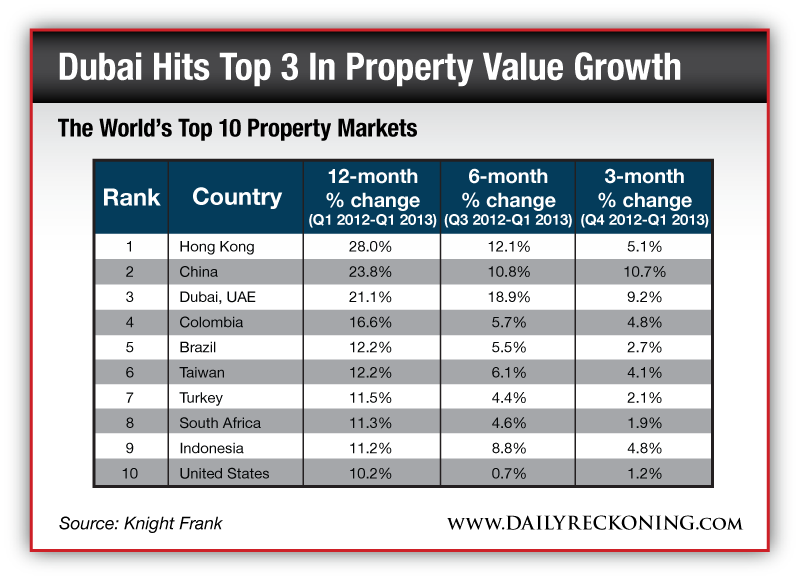
Peter was also a fan of Dubai real estate. The villas he tipped in his newsletter in April of last year are up 50% in value. And the Dubai property market ranks third in the world in terms of performance, with prices up 21% over the last 12 months, according to the Knight Frank global property index. (Only China and Hong Kong did better.)

Here are the top 10.

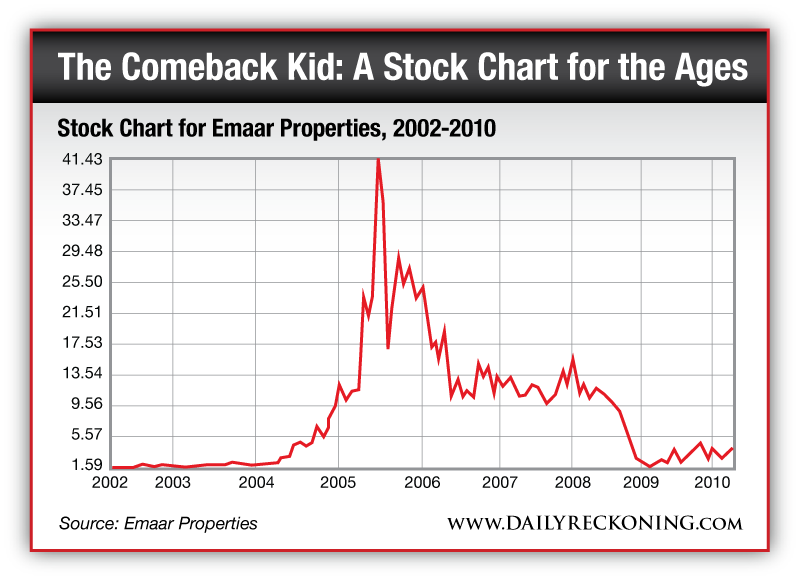
Dubai real estate also enjoys high rental growth -- about 18%, Peter says, year over year. He thinks real estate is probably fairly valued now, and I would agree with him. But you can still play Dubai property by owning Emaar Properties, which he believes remains undervalued. Emaar is the premier property company in Dubai and a good long-term play.

Its stock chart is one for the ages...


The recovery in share price is just beginning, Peter says. People are quick to point out that it will never see 41 again. But all this did happen before, in 1998-99. "I remember after it cracked then that people said it would never go higher than its old peak," Peter said, "but it did." Perhaps Emaar will not better its old high, but even if it gets to the teens, it will prove an excellent investment from here.

In the grand scheme of things, it was easy to see that Dubai's comeback was inevitable. Dubai is, as Peter put it, "the commercial hub of Arabia." It is the safe haven of the Middle East. It is the place where people put their money and property and even families to be safe. To some extent, turmoil in the Middle East benefits Dubai, as the money flows in.

As Peter says, "This is the region's most open, liberal and efficient city." Its airport is the fastest-growing airport in the world. It will pass Heathrow as the world's busiest international airport next year. Dubai also has the largest marine port in the region. And the city is a comfortable place to visit, with great hotels and restaurants.

Rising oil prices help the economic picture, too, although Dubai itself is not a significant oil producer. Rising oil prices increase the wealth of its neighbors, in particular Abu Dhabi, its sister city in the United Arab Emirates.

Dubai also has several built-in advantages. Foreigners operate in a tax-free environment. There are no tax forms to submit. Nobody cares how much money you are making.

Peter told a funny anecdote. "A true story," he says. "There was a chap in front of me at the airport. He put his sack through the scanner, and it was full of money.

"The security guy asked him how much money he had in the bag. 'About five hundred thousand dollars,' he told him.

"'No problem. Welcome to Dubai.' And off he went."

Dubai is a small economy with particular strengths, as Peter says. "I have never found another place like it in my long career," he said. "Modest talent can bring great reward in the UAE. You're not always up against the best in the world as in the USA."

Peter's newsletter is the best way I know of to keep up with the goings-on of Dubai. And as a 17-year veteran of Dubai and a man who made his fortune in the city, he is the best guide to its investment possibilities.
...
Enhanced by Zemanta

Why You Still Shouldn't Take This Famous Bet

Simon Mayo looking like Colin Murray
Simon Mayo looking like Colin Murray (Photo credit: markhillary)
By Investment U

Chicago, Aug.12, trading stocks .- As raw materials prices soared between 1998 and 2008, many analysts argued that we were in the midst of a commodities "supercycle," and that demand from fast-growing emerging markets - particularly China - would continue to drive prices up for years and years.

Like so many grand macroeconomic and geopolitical theories, however, this one fizzled. In 2008, for example, the DJ-UBS Commodity Index plunged 37%. And prices remain under pressure. The index is down 14% this year, while stocks are turning in a banner performance.

But with raw materials cheaper, is this the time to buy?
Probably not. And if you know about free-market economist Julian Simon's famous bet, you'll understand why...


In 1980, Simon entered into a wager with Paul Ehrlich, a famously gloomy "futurist" and author of The Population Bomb, a book that argued that world population growth was outstripping the fixed supply of resources and would soon cause a global economic catastrophe.

Simon was skeptical and bet Ehrlich $1,000 that any five raw materials he selected would be lower 10 years later. Ehrlich agreed and chose five metals he expected to undergo large price increases: chromium, copper, tin, nickel and tungsten.

Between 1980 and 1990, the world population grew by 800 million - the biggest increase in history. Yet each of Ehrlich's selected metals dropped. (In the case of tin, by more than 50%.) Thanks to technology and substitution, commodity prices tend to decline from high levels and, in fact, have done nothing more than track inflation over the long haul.

But low long-term returns are only one reason to avoid or minimize commodity investments. Another is that they don't produce any income. Without dividends or interest payments, you're counting entirely on price appreciation - and history shows that is minimal over the long haul.

Another hurdle is high expenses. Most commodity mutual funds and ETFs don't actually own the soybeans, natural gas or metals they track. Instead, they own contracts that give them the right to buy those commodities at a set time in the future.

As the contracts mature, they "roll" them into later months. But this is expensive, and many funds that invest in commodities have expenses 15 to 20 times higher than the typical .05% of stock and bond ETFs.

If you own just a plain-vanilla S&P 500 index fund, 14% of that money is invested in basic materials and energy companies. So the chances are that you already have low-risk exposure to world commodity markets.

However, I should point out one part of the commodity sector that appears poised for exceptional growth: oil and gas pipeline companies.

These companies, called master limited partnerships, will benefit as booming energy production meets rising demand in the U.S. Aside from being insulated from the ups and downs in energy prices, these vehicles also offer tax benefits. (That's one of the reasons we own Plains All American Pipelines - up more than 70% - in our Oxford Trading Portfolio.)

In short, Julian Simon was right. Direct commodity bets are volatile, expensive and tend to be low-returning over the long haul. The Oxford Club suggests you keep them at 5% or less of your portfolio.

...
Enhanced by Zemanta

Don't Bet Against an Electric Market

Image representing Tesla Motors as depicted in...
Image via CrunchBase
By Rude Awakening

Baltimore, Aug.12, top stocks .- The stock market and electric cars have a lot in common these days. I'll explain what I mean in just a minute. But first, as I sift through the financial headlines this morning, I'm reminded of an old Wall Street adage…


Bears make headlines. Bulls make money.

In other words, I'd be more inclined to think this market is heading for a substantial crash if that wasn't the default opinion right now…

Here's how they're playing the game: Financial pundits and gurus are screaming about an impending crash (as they've done all year, of course) while analysts are quietly raising their end-of-year forecasts.

"At the beginning of 2013, when the S&P 500 was at 1426, none of Wall Street's leading prognosticators had 1700 on their radars," reports the Wall Street Journal. "Now, at least seven strategists expect the index will finish above 1700 by year's end."

So the analysts and strategists play catch-up. And the fund managers once again find themselves well behind their benchmarks. Everyone is cautious. Not exactly the recipe for a catastrophic plunge…

Of course, the bearish chatter will get louder if the market dips more than a few percentage points this month or the next (which is entirely possible). Your job is to keep a level head and search for opportunities while everyone else is loading supplies into their doomsday bunkers.

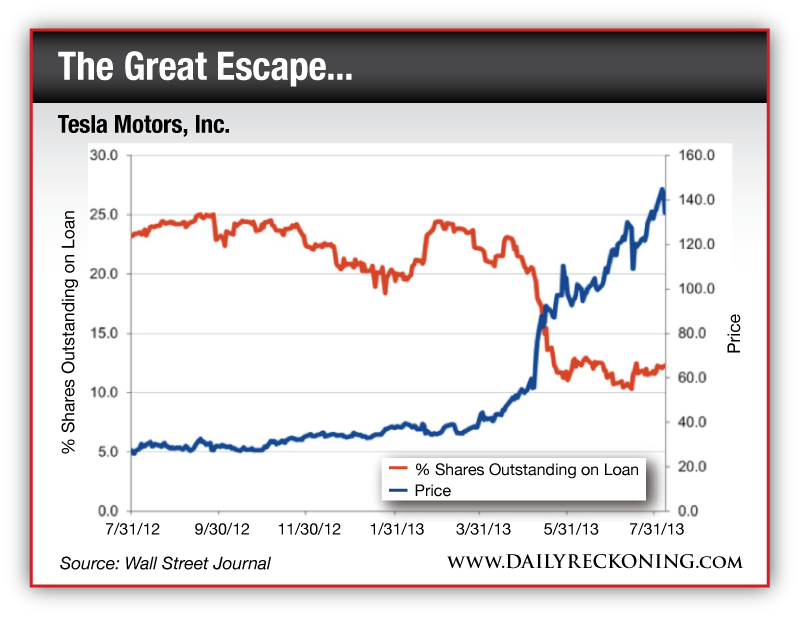
Which brings me to Telsa— an apt metaphor for the broad market today.


Toward the end of last year, Tesla shares were considered ridiculously overpriced by many analysts and investors. Short interest was close to 25% just as the company started ramping up production of its well-received Model S sedans.

When the stock hit $40 back in April, no one expected it to see challenge $50. Yesterday, it closed above $150. [Ed. Note: My colleage Jonas Elmerraji had his readers in on Tesla from the very beginning. Click here now to see how you could start making these kinds of gains today.]

Tesla marched higher—stomping out the shorts in the process.

There's no shortage of bearish sentiment, fear, and caution bubbling under the surface of this market. Use it to your advantage as stocks consolidate this week…
Enhanced by Zemanta

Thursday, August 1, 2013

Are Gold Stocks on the Cusp of an Upswing?

The Federal Reserve: The Biggest Scam In History
 (Photo credit: CityGypsy11)
By INO


Chicago, Aug.1, best stock .- The Gold Report: Ron, the Federal Reserve has decided to continue quantitative easing (QE) for the foreseeable future. Gold has risen steadily since that news. Is that what you predicted the Fed would do?
Ron Struthers: It is not that hard to predict the Fed's behavior when you understand what it's trying to do and how it's trying to do it. I do not take what they say literally, except within the context of its goals. The Fed is trying to instill confidence in the economy because of massive U.S. debt and its future debt appetite. The economy needs to improve for there to be higher tax receipts. We need foreign investment to finance the debt. If the Fed can convince Americans and those abroad that its bonds are the safest/most attractive, its stock market will have the best returns and that debt machine keeps running.
But the truth is that the economy is very weak. Employment is weak. Foreign investment has been fleeing. The Fed has to purchase $85 billion of debt a month because nobody else will. The Fed can't do this forever, and it knows it. It has to talk as if the economy is improving so the Fed debt purchases can end in the near future.
If you dig into what's really going on in the economy and markets, you'll find the underlying weakness that guarantees that QE will be here for a long time, as least as long as the markets themselves will allow it or are tricked into allowing it.
TGR: Why are Americans so complicit in this?
RS: Too many take for gospel what they read and see in the mainstream media. There's a pretty good media propaganda machine out there for the government.
TGR: Do you think the Fed should exist?
RS: I've never gotten into whether it should exist or not. Let's just deal with what we have. I do think that its hand has gotten way too heavy in the markets.
TGR: Now that QE is going to continue for a while, what is the trade in gold and where are the catalysts for an even higher gold price?
RS: We've been waiting for a bottom. We've seen that now, and it's time to buy. There are still a lot of the same catalysts, such as many central banks are switching out of the dollar, yen, euros and diversifying to gold. Continued QE just means a continuation of that diversification.
Asia still has record demand for physical gold. Since the Bank of Japan announced the most aggressive QE program thus far, Japanese funds and the pension funds have started to buy gold-related investments; this is a first and has only just begun.
Since the price drop, we've seen a lot of mine closures and curtailment, which will only result in less supply in an already tight physical market.
However, the main catalyst is the reason gold was driven down in the first place. It has run its course and that was fulfilling the goal of the bullion banks.
TGR: Which is?
RS: The bullion banks run a fractional reserve gold system just like the bank system, meaning they only have one ounce of gold for every 50, maybe even 100 or more, sold. We don't know the exact numbers, but it's something along that line. That system came under stress with the lack of confidence and was driven, in part, by major countries like Germany repatriating gold. The fact that it is going to take seven years for Germany to get its gold tells you something about this fractional reserve system.
The bullion banks were, and are still, seeing a run on their physical reserves as inventories are falling, and so are the COMEX inventories. But at the same time, the bullion banks had this huge short position in gold and silver. We've seen a behind-the-scenes rescue of these bullion banks, at least for now.
TGR: In a recent edition of Struthers' Resource Stock Report, you said that many of these bullion banks are actually long gold now.
RS: We don't know exactly what any one bullion bank does, but we get some very good clues from the weekly COMEX Position of Traders report. The section of the report called "The Commercial," which includes the bullion banks, shows the reported short and long positions. We have seen a large net short position there for many years. But with this big drop in gold prices, that short position has been taken down to near nothing. At the same time, we've seen the category where we find the speculators and hedge funds at record net short levels. The short position has been moved from the strong hands to weaker ones. I see this as another bullish signal.
TGR: You also see some weakness in the recent jobs data. Tell us more about that.
RS: We hear the U.S. headline job number, talk about all these jobs we're creating and how good it is. The devil is in the details, they say. The last report actually saw 220,000 full-time jobs disappear. All the gains were part-time jobs. Right now, the second largest employer in the U.S. is a temp agency, and some 10% of the workforce is temporary because companies can't afford full-time workers or have little confidence for that commitment. That's a big sign we never have seen a real recovery.
Only 47% of Americans have full-time jobs. Some people have two part-time jobs now. The same person working in two places counts as two jobs, but it's just one person. The previous month's report sounded good, too. It reported more new jobs, but the hours of work dropped. I just see these employment numbers as part of the virtual economy, not the real one.
TGR: Do you believe that gold has already bounced off of its 2013 bottom?
RS: I think so. The $1,1001,200/ounce ($1,1001,200/oz) barrier was a good support level for gold, and we bounced out of that. I think we've seen the bottom. I thought we could possibly see a retest of that support, but because gold has done so strongly already, I think a retest of that becomes less likely now.
TGR: A group of Canadian financial companies led by the Royal Bank are attempting to launch a stock exchange to rival the Toronto Stock Exchange (TSX). The carrot at the end of the stick seems to be the elimination of predatory trading by computer-based programs. Does this idea have any traction?
RS: It has traction given that a large bank is behind it. I talk to investors and traders almost daily, and they've been fed up with computer trading for quite a while. Very simply, it's just totally unfair. Orders are not real and come and go quicker than humans can act.
"If you dig into what's really going on in the economy and markets, you'll find the underlying weakness that guarantees QE will be here for a long time."
Maybe you see a bid for 1,000 shares on some stock. You try to sell, but the computer sees your order coming, maybe fills 200 and then reduces the bid and you remain unfilled. You can take lower and lower prices if you want.
The same with buying. More shares can show up less than a second after you buy, so you don't know how many shares there are on offer, who is selling, how much or whether something is wrong because there's so much selling. Sometimes you don't even see your trades. You'll see, say, a bid at $0.35 and an offer at $0.40 on some particular stock. Maybe you put an order in to buy at $0.40, and you see no trade go through, but your brokerage account shows filled. The next day you find it settled at $0.38 because there was an offer there from a different trading platform.
For the most part, these different platforms are computer-driven participants. It has induced a huge lack of confidence and unfairness in the markets. It created two playing fields: the rich, big players and the small investor on the bad end of the stick.
What is also unfair is that these computer trades are given a rebate or less fees on their commission, so they're even given an advantage on commissions over regular investors. They say it's in the name of supply and liquidity, but it's just another unfair practice.
TGR: Wouldn't the Toronto Exchange argue that it's not a profitable enterprise without computer trading?
RS: I'm sure it is going to put up any kind of blocks that it can.
TGR: This sounds like an almost ideal bourse for junior mining stocks. What incentive would the new exchange offer for companies to come over?
RS: I don't think they will have to actually come over; TSX-listed companies could trade there. It would operate like another trading platform. The TSX has already lost about 40% of the volume to other trading platforms out there now like Alpha. This bourse is still in a discovery period right now. It's still exploring all the options for how to work this. It has an outline, but the goal is to go with a formal application around year-end. If it makes an official application by year-end, we could see this in 2014.
One thing I found quite interesting is it would take private company shares. A brokerage could take in the shares and create a market, creating some liquidity for private companies.
TGR: Why would private companies list? They have no desire to make their financials public.
RS: They actually don't list but it creates some liquidity for their current shareholders. At the same time, they don't have the regulatory burden as a public startup company. They can put more money into their companies and bring them to a stronger level before going public.
TGR: Without the transparency, investors could lose a lot of money.
RS: On the private sector side, it would only be qualified/accredited investors under the current TSX guidelines that could own and trade in these shares.
TGR: Is there any word from the federal government on whether it would back a new exchange such as this?
RS: I haven't heard much yet. This just came out at the end of June. We're going to hear lots about it between now and year-end, but it's just in its infancy now.
TGR: You follow a number of small-cap, mid-cap and large-cap gold and silver equities. Please outline your thesis for the small-cap silver and gold equities.
"I keep a long-term outlook. We have these ups and downs. This has been the worst, but this could be the fourth good correction."
RS: We use stop losses, and we got stopped out of almost all of our gold stock positions quite a while ago. I've never seen anything like it, but the market is what it is. Seeing a bottom, we first started going in and buying back the larger and midtier producers and some of the junior producers. Then later on, we'll start adding more of the exploration plays as long as the market keeps advancing.
TGR: What are some junior companies you're writing about in Resource Stock Report?
RS: Claude Resources Inc. (CRJ:TSX; CGR:NYSE.MKT) is one I recently bought back. I couldn't believe how far that got beat downto about $0.20/share. The main reason was that its costs are high at around $1,245/oz. However, it just completed a shaft extension at its Seabee mine that will reduce costs. It already has higher costs at the first of year because it has to restock its mine utilizing winter ice roads. The restocking program went well this year, with lower costs than last year and lower costs in many consumables. Given that and the recovery in the gold price, we could see quite a turnaround in that stock.
TGR: Claude posted a loss of $0.01/share in Q1/13. Is it on track to turn that around?
RS: The extra leverage you get is another advantage when you buy companies with costs very close to the current price. A $100/oz increase in gold would turn it from losses to profits. Just that $100/oz can make quite a difference, and you can see that leverage reflected in the improvement in the stock price.
TGR: Where is the growth going to come from, Ron?
RS: It is going to get some growth from the Seabee mine, but the big growth is going to come from its Madsen project in Red Lake, Ontario. It actually has more gold resources there than its mine. It has been advancing that project. Bringing that into production down the road is going to provide quite substantial growth.
TGR: What is another junior story?
RS: Richmont Mines Inc. (RIC:TSX; RIC:NYSE.MKT) has 2 million ounces (2 Moz) in reserves and resources and is producing about 65,000 ounces (65 Koz) a year. Its cash cost was high last quarter, at $1,300/oz, but that should improve. It had lower grades mined the previous quarter, which is going to improve in H2/13. It is also putting a new W Zone at the mine into production. It did a successful bulk sample test, at grades of 5.3 grams per tonne with 97.4% recovery.
The company has always been managed very prudently. It only has 40 million (40M) shares out, a strong cash position of $43M and less than $1M in debt. It has a $50M loan facility available as well, so it is in a strong position. The market is valuing its mines and ounces at just $20M right now. If you look at 2 Moz reserves and resources, they're valued at $10/ozand that's at a producing mine. I just find that ridiculously cheap, but the market is ridiculous now.
TGR: Do you think Richmont would use its cash position to take advantage of some other players that are not as cash rich?
RS: I don't think so. The management's track record is to more or less invest internally. It is more apt to improve the current mines and to acquire and advance some other properties. It could take advantage of acquiring properties off some of these other companies instead of taking out a whole company.
TGR: You mentioned its cost of production was a touch high. What is it doing to remedy that?
RS: The high costs are a short-term issue. It will get by this as the year progresses and fall more in line with normal grades that are a bit higher. This additional zone is a higher grade zone that will help with that. It's also paring costs wherever it can, cutting corners here and there like all the gold miners now.
TGR: What other stories are you following?
RS: On the senior side, I added Newmont Mining Corp. (NEM:NYSE) recently.
TGR: Because of the yield?
RS: Newmont gives good leverage as a dividend play because its dividend is based on the gold price. The dividend was $1.40/year, which is yielding about 5%, but that's probably going to drop to about $0.80/year because of the current gold price.
The dividend goes by the average of the previous quarter. The dividend increase is for every $100/oz increase in gold, $0.20/year. Once gold hits $1,700/oz, then it increases $0.30/year for every $100/oz increase. At $2,000/oz gold, it jumps $0.40/year for every $100/oz increase. That's some pretty good leverage there. If we get to $2,000/oz gold, the dividend would be $2.70 each year per share.
For now, I'm just betting gold recovers and Newmont is at least paying $1.40/share. That would give us a 5% yield at the current stock price.
TGR: Is yield the only reason why Newmont hasn't been beaten up like Barrick Gold Corp. (ABX:TSX; ABX:NYSE)?
RS: They've all been beaten up pretty good. Maybe Newmont was spared a little because of the yield. Most of the majors are paying some kind of dividend now, but Newmont is among the highest.
TGR: Are there some distressed names that offer compelling value in this market?
RS: They're all distressed at this point!
I've been looking at another good company that is quite interesting in South Africa. I haven't picked much up there for a long time. Gold Fields Ltd. (GFI:NYSE) spun a company out of its holdings this year to create Sibanye Gold Ltd. (SBGL:NYSE). It came out trading around $7/share in February, just in time for the market to get hammered, and it dropped all the way down to a few bucks.
It is actually going to be the third largest producer in Africa behind Gold Fields and AngloGold Ashanti Ltd. (AU:NYSE; ANG:JSE; AGG:ASX; AGD:LSE). The trailing price-earnings ratio is just 2x earnings. It had a very positive Q1/13 with $170M profit and $66M free cash flow. Falling gold prices would naturally have an effect, but its impact has been overdone on the share price. Sibanye has two producing mines and offers good value down at these prices.
TGR: Why did Gold Fields decide to spin it out?
RS: It wanted to split its mining into two types. It spun out narrow-grade, underground mining that's labor intensive. Its other projects are more open-pittable, bulk scenarios with more machinery-type mines. It felt it was trying to manage two different types of mines. Now there is better concentration with a split along synergies.
TGR: Could you give us another small-cap name?
RS: Argonaut Gold Inc. (AR:TSX) has not been beaten down nearly as much because its costs are quite low at around $600/oz. The company has two producing mines and produced 93 Koz last year. It is projected to increase to 120140 Koz this year. Argonaut has two advanced projects under economic assessment, two more mines that could come onstream down the road. It should be able to fund all this internally because it is sitting on $168M in cash and has no debt. Argonaut could be a stock that could continue to outperform in the market going ahead. It's quite a good growth story.
TGR: How are you staying positive throughout what's happening in the junior mining sector?
RS: I keep a long-term outlook. We have these ups and downs. This has been the worst, but this could be the fourth good correction. Each time, these corrections get a little bigger and a little longer, but they're from bigger and higher prices. The next move will be a bigger and longer upmove. That's the carrot for belief in what's yet to come. Being that these stocks are so depressed, it's the best buying opportunity that I've ever seen, even better than in 2000 at the bottom.
TGR: Are you buying?
RS: Yes. I like the long-term call options on some of these majors, too. Because the market is so beaten up, the call premiums have gone to nothing. You can buy these call options that are out a year-and-a-half for $1 or $2 and control a $510 stock. There's a lot of leverage there.
TGR: Thank you for your insights.
For Ron Struthers' investing ideas on graphite, click here.
Ron Struthers founded Struthers' Resource Stock Report almost 20 years ago. The report covers senior and junior companies with ample trading liquidity. Since 2000, $1,000 invested in Struthers' Model Portfolio ended 2012 at $9,251. Struthers' Newsletter Stocks went from $1,000 to $20,934. Struthers' Millennium Index, which started in 2003, began at $1,000 and was worth $4,133 at the end of 2012.
Want to read more Gold Report interviews like this? Sign up for our free e-newsletter, and you'll learn when new articles have been published. To see a list of recent interviews with industry analysts and commentators, visit our Streetwise Interviewspage.

DISCLOSURE:
1) Brian Sylvester conducted this interview for The Gold Report and provides services to The Gold Report as an independent contractor. He or his family own shares of the following companies mentioned in this interview: None.
2) The following companies mentioned in the interview are sponsors of The Gold Report: Richmont Mines Inc. and Argonaut Gold Inc. Streetwise Reports does not accept stock in exchange for its services or as sponsorship payment.
3) Ron Struthers: I or my family own shares of the following companies mentioned in this interview: Claude Resources Inc. and Richmont Mines Inc. I personally am or my family is paid by the following companies mentioned in this interview: None. My company has a financial relationship with the following companies mentioned in this interview: None. I was not paid by Streetwise Reports for participating in this interview. Comments and opinions expressed are my own comments and opinions. I had the opportunity to review the interview for accuracy as of the date of the interview and am responsible for the content of the interview.
4) Interviews are edited for clarity. Streetwise Reports does not make editorial comments or change experts' statements without their consent.
5) The interview does not constitute investment advice. Each reader is encouraged to consult with his or her individual financial professional and any action a reader takes as a result of information presented here is his or her own responsibility. By opening this page, each reader accepts and agrees to Streetwise Reports' terms of use and full legal disclaimer.
6) From time to time, Streetwise Reports LLC and its directors, officers, employees or members of their families, as well as persons interviewed for articles and interviews on the site, may have a long or short position in securities mentioned and may make purchases and/or sales of those securities in the open market or otherwise.
...
Enhanced by Zemanta