"No man can become rich without himself enriching others"
Andrew Carnegie


Showing posts with label hot stock picks. Show all posts

Thursday, August 22, 2013

The Timeless Wisdom of Izzy Stone

Stones
Stones (Photo credit: rkramer62)
By Daily Reckoning
Chicago, Aug.22, free stock tips .- "I sought in political reporting what Galsworthy in another context had called 'the significant trifle' -- the bit of dialogue, the overlooked fact, the buried observation which illuminated the realities of the situation." -- I.F. Stone, The Haunted Fifties (1963)

I start with a hidden problem in the stock market's latest earnings report card. Overall, earnings rose about 2% for the quarter. But if you take out the financials (banks, insurers), earnings actually fell by 3%.

That's a problem.

I appeared on Fox TV Friday morning. Before the show, I said I wanted to talk about this earnings stuff. The producer asked, "Do you think that's too technical to explain?"

"I should hope not" I thought to myself. I hope people understand that earnings (or profits) drive the stock market over the long term.

Specifically, the market rises and falls based on what the consensus guess is about where earnings are going. The market looks ahead. So you can match up the S&P 500 -- a broad proxy for the market -- with the consensus guess for earnings in the coming 12 months (the so-called "forward estimate").

Take a look at this chart from FactSet, which shows just that.


So if earnings fall -- or if people start to think earnings will fall -- the stock market also tends to fall. This is simple stuff. Trying to predict what will happen is, of course, anything but simple. I'd say it's foolish to even try. But people love this kind of thing -- especially TV people.

I was on Fox last week, on Aug. 7. I expressed the usual caution about the market, which I've been doing in these pages all year. Asked if it was time to sell, I said "Absolutely." I told viewers that my C&C portfolio was down to just nine names. We have historically carried 20-25.

Anecdotally, I said, that tells you what I think of the market. It was a lucky call, because the market has done nothing but drift lower since. (It got me a return invite. They want to know what I think now.)

People are starting to worry about earnings. They are also worried about when the Fed will stop pouring free drinks and end the party -- which, in a roundabout way, still comes down to a worry over earnings.

The earnings for the second quarter seem to foreshadow a decline ahead.

I've already pointed out the fact that if you exclude the banks, earnings actually fell. In some sectors, the decline was ferocious. The mining sector's profits were off 59%. (Fortunately, we put ourselves in a great position here. We long ago dumped all of our miners and commodity plays. Instead, we bought the financials. Today, we enjoy the profits -- and savings -- of that decision.) The overall growth in earnings was the third-slowest growth rate in the past four years (or 16 quarters).

Also, the number of positive surprises was the lowest since 2008. And of the number of companies that gave guidance for the third quarter, about 80% have issued negative guidance. Meaning they've taken their forecasts down a notch or two. As a result, the expected earnings growth rate for the third quarter is 4.3%, down from 6.7% at the start of the quarter. That figure is still probably optimistic.

In summary, for anyone who takes a deeper look into the market's working engine (those earnings), there are plenty of worn-out parts that look like trouble down the road.

Taking a deeper look is what Izzy Stone was all about.

I.F. Stone (1907-89), or "Izzy" as he was known, wrote and self-published a newsletter called I.F. Stone's Weekly for nearly two decades. It was influential in its time. At its height in the 1960s, Stone had about 70,000 subscribers.

His focus was political reporting. He was famous for digging through the public record and finding things that people missed. As he described it so eloquently, "I sought in political reporting what Galsworthy in another context had called 'the significant trifle'-- the bit of dialogue, the overlooked fact, the buried observation which illuminated the realities of the situation."

His work has earned him a place among the best investigative reporters that ever lived. I find him inspirational in my own efforts in trying to put together a newsletter attuned to those same "significant trifles." Stone would've made a heck of a financial newsletter writer.

Among my favorite nuggets of wise advice from Stone:

"If you're going to be a newspaperman, you are either going to be honest or consistent. If you are really doing your job as an observer... it's more important to say what you see than worry about inconsistency. If you are worried about that, you stop looking. And if you stop looking, you are not really a reporter anymore. I have no inhibitions about changing my mind."

I don't think I have to point out how this applies to markets. Certainly, if you come at the market with a strong view, you are apt to overlook the possibly important trifle that doesn't fit your worldview. And that trifle might be the clue that gets you ahead of the crowd.

More from Stone:

"The search for meaning is very satisfying, it's very pleasant, but it can be very far from the truth. You have to have the courage to call attention to what doesn't fit. Even though readers are going to say, 'Well, two weeks ago you said this.' So you did. And maybe you were wrong then, or partly wrong, but anyway, you've just seen something that doesn't fit, and it's your job to report it. Otherwise, you're just the prisoner of your own preconceptions." [Bold added.]

This is not just for newsletter writers. This is for thinking people everywhere.

We should realize that we are all, to some extent, prisoners of our preconceptions. And we should all work to not let those preconceptions blind us to opportunities (or pitfalls) staring us in the face. Aim to take opportunity (and see trouble) where it lies, and don't try to force the market to live up to your preconceptions.

Izzy's world had its center in Washington. Our focus is Wall Street. Both places have many affinities. Power and money are their chief currencies. Deception and sleight of hand are common skills. It's easy to get discouraged when you get close. Izzy never did.

"I felt that if one were able enough and had sufficient vision," he once wrote, "one could distill meaning, truth and even beauty from the swiftly flowing debris of the week's news." Stone's essays did that with wit and good writing.

If you are interested, I recommend The Best of I.F. Stone as a starter. If you want more, you can move on to Stone's six-volume A Nonconformist History of Our Times, which starts in 1939 and runs until 1970. I've also read two excellent biographies: All Governments Lie! by Myra MacPherson, and American Radical, by D.D. Guttenplan.

I live in a suburb of Washington, D.C. (If you step outside and listen closely, you can hear the beating heart of the Empire.) Last night, I headed down to the Penn Quarter to meet a couple of friends for dinner. Izzy used to write his Weekly from Washington and lived only a couple of miles from where I was.

It's unseasonably cool in Washington. We ate out on the patio at chef Jose Andres' Jaleo restaurant. (Best tapas restaurant in town.) My friends were globe-trotting investors, and I was hoping to get a useful lead or two. And I did. Never stop looking, Izzy used to say. More another time...
...
Enhanced by Zemanta

Great Company, Unstable Dividend

An assortment of United States coins, includin...
An assortment of United States coins, including quarters, dimes, nickels and pennies. (Photo credit: Wikipedia)
By Wealthy Retirement

New York, Aug.22, free stocks .- Blackstone Group L.P. (NYSE: BX) is one of the world's largest and most successful investors. It runs a diverse group of funds that invest in a wide variety of assets including stocks, real estate, private equity, etc. Blackstone has nearly a quarter of a trillion dollars under management.

The company makes a lot of money. In the first six months of the year, its profit was $938 million. That's up significantly from $512 million the year before.

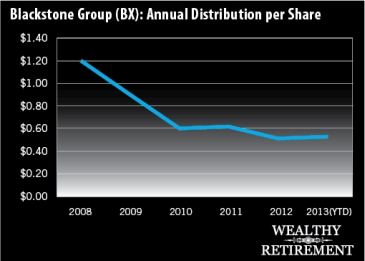
And Blackstone pays a decent dividend. In the first six months of the year, it has paid $0.53 per share. Annualized, that comes out to a healthy 4.9% yield.

However, the dividend fluctuates strongly from quarter to quarter and year to year.

In the first quarter, the distribution was $0.30. The second quarter distribution fell to $0.23. So for an investor who needs a reliable income stream, Blackstone doesn't deliver.

You can see from the chart below, the company's dividend history has been all over the place. It lowered the dividend in 2009 and 2010. Raised it slightly in 2011, cut it in 2012 and now will grow the dividend in 2013.


In the first six months of the year, the company's distributable earnings (a measure of cash flow) was $729 million. During that time, it paid out $905 million in distributions. Last year at this time it also had paid out more in distributions than it earned.

The company has a policy in place that the dividend will be at least $0.12 per share, even if it has to "borrow" money from future quarters to pay for it. Fortunately for shareholders, the company hasn't needed to do that yet, but it is possible it will in the future if business takes a bad turn.

When I discuss the safety of a dividend in these Safety Net columns, my main goal is to try to figure out if the dividend will be cut in the not-too-distant future. Although I always prefer dividend growth, a stable dividend will still merit a high rating.

Unfortunately for Blackstone shareholders, the dividend is anything but stable.

That doesn't mean it will get cut to zero. Blackstone is a very well-run company that makes lots of money. But it has no track record whatsoever to speak of when it comes to a stable dividend. Some years it goes up. Others it comes down by a significant amount.

Blackstone may be a suitable investment for those who are looking for growth (I haven't analyzed the stock for its growth prospects) and who will be happy with whatever income they happen to get.

Other investors who see that 4.9% yield and are willing to take their chances that the dividend doesn't get reduced too much in the future could wind up happy too. I'm not saying they will, just that it's a possibility.

But since this column is all about safety, I have to warn investors who need a reliable quarterly dividend check that Blackstone is NOT for you. Its dividend is just way too unpredictable. You never know what you're going to get in any given year.

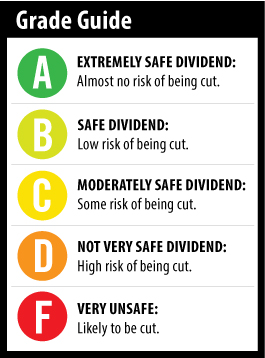
Dividend Safety Rating: F

If you'd like me to review the dividend safety of one of your stocks, leave the ticker symbol in the comments section below. But before you do, check to see if I've written about it already. Enter the ticker symbol or name of the company in the search box in the upper right corner of the website.

Enhanced by Zemanta

52 Members Of Congress Own This High-Yield Stock -- Should You?

United States Capitol Building
United States Capitol Building (Photo credit: Jack's LOST FILM)
By Street Authority

Washington, Aug.22, hot stock picks .- It's the most popular high-yield stock owned by Congress. And they might be on to something. Right now this stock yields 5.3%… and it's one of the most stable dividend-payers in America. During the recession, dividends stayed steady. And in the past five years investors have enjoyed five annual dividend increases.
At last count, 52 members of Congress -- 19 Democrats and 33 Republicans -- owned shares of this company.
I'll tell you more about the stock in a moment. But first, I think you should understand why it's important to know that Congress owns the stock at all...
A few years back, "60 Minutes" finally blew the lid off the entire thing.
To make a long story short, insider trading was legal for members of Congress and many of their high-ranking aides for years. They could trade based on the information they encountered in their day-to-day work, even it if it was non-public information.
We had been telling readers about this for months before Congress finally changed the rules. In fact, we even put out a special report -- Congress' Dirty Secret -- that outlined the problem and also showed people how to find out what their Congressman owned with a few clicks of a mouse.
But there's no illusion here. We could scream about the problem until we're blue in the face. However, when "60 Minutes" -- one of the most-respected investigative journalism programs on television -- dedicates a segment to the issue, the nation pays attention.
And we were happy to see all that attention lead to a change with the passage of the STOCK Act. There's no doubt that this was a problem. According to data from the Center for Responsive Politics, 247 of the 535 members of Congress are millionaires. That's 48%! In other words, being a millionaire makes you "average" in Congress.
Meanwhile, according to a Barron's story, members of Congress outperform your typical investor by an extra 6.8 percentage points each year.
Knowing all that, you would think looking at the most popular stocks in Congress would shed light on some super secret investing strategy that would produce better returns than everyone else. After all, they could make trades based on insider information.
But according to Factset, a research firm specializing in money in politics, the most popular dividend stock owned by Congress is one of the best known companies in the world. And though the rules have changed to disallow Congress from making investments from insider information, the most recent data available is from 2011, before the STOCK Act passed.
And let me be clear. We're not suggesting that Congress had inside information on AT&T (NYSE: T) -- the high-yielding stock that's owned by more than 50 members of Congress (that makes it the most popular income stock owned by our representatives).
However, when dozens of millionaires with a history of beating average investors year after year own a particular stock, we think it's smart to pay attention.
Obviously, AT&T won't make you a millionaire overnight, but it is one of the most stable businesses in America. The shares fell with the broader market during the recession, but the underlying business kept steadily making money.
Today the company takes in about $127 billion in revenue each year and has about $4.5 billion in cashsitting in the bank. AT&T returns roughly $10 billion annually to investors in the form of dividends. And those payments have increased every year going all the way back to the 1980s.
I'm not necessarily recommending you snap up some shares of AT&T, but there is plenty to like about the stock... and importantly, Congress seems to agree.
While some investors will view AT&T as a "boring" old company past its prime, I view it as an established company that is worth owning for the long haul, complete with a 225-country-strong market position, billions of cash on hand and huge $20 billion annual cash flows that will help it acquire smaller competitors and keep growing its dividend for years.
It's traits like these that have rewarded long-term AT&T shareholders -- and Congress -- handsomely over the past decade. It's a major reason why AT&T has more than doubled the S&P 500's performance...
As the millionaire members of Congress may have already figured out, serious investors who ignore these long-term, market-beating traits are making a huge mistake. If you're not allocating some of your portfolio to strong companies like these and letting the returns compound year after year, you're missing one of the most important forces in the market. ...
Enhanced by Zemanta

Tuesday, August 13, 2013

Enhanced Oil Recovery with Competitive Costs

Texas Barnett Shale gas drilling rig near Alva...
Texas Barnett Shale gas drilling rig near Alvarado, Texas (Photo credit: Wikipedia)
By INO


Austin, Aug.13, hot stock picks .- The Energy Report: On July 26, George Phydias Mitchell died at the age of 94. The late Texas oilman had pioneered the use of horizontal drilling and hydraulic fracturing. Can you speak about his achievements?
Jim Letourneau: Mitchell was the founder of the entire shale oil/shale gas revolution. For decades, the Texas wildcatters had known that there was gas in the Barnett Shale, but it was very difficult to get it out. Mitchell did not invent the fracking technologies. He just wanted to get the gas out of the shale. And as the owner of an oil company, he got to challenge the technical people. He basically said, "If you guys can't figure it out, I'll find someone who can." He had the power and the money and the persistence to make it work. Mitchell Energy Development Corp. began working on the problem in 1981, and it took until 1999 to figure it all out. The company sold for $3.5 billion ($3.5B) in 2001! It is inspiring.
TER: Were other companies trying to develop fracking?
JL: The conventional wisdom did not comprehend what George Mitchell was attempting; some folks thought he was crazy. And since some visionaries fail, we need to celebrate the ones who are successful. He grew to be very wealthy as an oilman, but he had also read the book, "The Limits to Growth," and he was very concerned about how civilization is managing the earth's resources.
TER: The extraordinary success of fracking has brought the prices of petroleum products below the cost of production, in some cases. What kinds of adjustments are the juniors that are already producing product in the North American shale field having to make in order to turn a profit, or even to just survive intact until the next boom?
JL: Because horizontal wells cost anywhere from $515 million ($515M) to drill, the juniors typically need to partner with a larger company. The big companies wait for juniors with nice land positions but not much capital to get desperate; then they move in to strike a deal.
The giant shale plays are not junior friendly, because small firms do not have the hundreds of millions of dollars needed to develop them. Thirty million dollars sounds like a ton of money, but it might only fund two wells. Statistically, it might be necessary to drill up to 10 wells to prove up a play. Typically, it's the majors that develop the new fields, and the juniors try to tag along by capturing acreage in a hot play, and that is often a good strategy. But they can't afford to spend big money to crack the code. They usually look for partners.
Even medium-sized big companies like EnCana Corp. (ECA:TSX; ECA:NYSE) are entering into partnerships with foreign companies and looking for big investors, because the amount of money required to develop these plays is so enormous. In Northeast British Columbia, literally billions of dollars of investment will be required to fully develop the resource. If a junior's land position is compelling enough, it can get a big payday from selling it. The challenge is that there are numerous shale opportunities for major oil companies to pursue and a junior needs an asset that is big enough to move the needle.
TER: For companies with producing wells, what kinds of new technologies are available to increase productivity without hurting already stressed out operating budgets?
JL: There are a lot of technological tricks with minimal costs: A producer can re-enter wells or stimulate wells or fracture older wells. It can enhance oil recovery with pulsed injection of water or chemicals.
TER: How does that work?
JL: A tool installed in the well injects fluids in pulses pumping like a heart pumps. Think of putting a kink in a garden hose. Pressure builds up and when the kink is released there is a strong pulse of water. This technology is efficient and companies can make money doing enhanced oil recovery with pulsed injection.
TER: What names are on top of that technology?
JL: Wavefront Technology Solutions Inc. (WEE:TSX.V) provides pulsing tools to operations all over the world. It has a couple new business lines with fantastic growth rates. In well stimulation, a chemical (usually acid) is injected into a formation to clean up the area around the well bore so that more oil and gas can flow. By using pulsing, the acid is placed more uniformly and better flow rates are achieved after the stimulation. This part of Wavefront's business is growing very quickly and now accounts for roughly half of the company's revenue.
Wavefront's pulsing technology has been modified for use in performance drilling tools. Fluid pulsing behind the drill bit and drill string agitation dramatically increases the rate of penetration. Reducing drilling time by 2040% is an easy sell, and the enhanced oil recovery business has a huge market in the field.
In another five years, these technologies will be commonplace, but it takes time since most oil companies are slow to adopt new technologies. It is going to take a few more quarters for Wavefront's revenue to ramp up, but its revenue growth is encouraging and I am quite optimistic about its prospects.
TER: How is its cash position?
JL: It has over $11M in cash. It is very close to being profitable, and it has more than enough money to see it through. The bottom line is that it has a market cap of about $25M and a rapidly growing business.
TER: How is Wavefront's stock performing?
JL: The share price is approaching all-time lows. A couple of weeks ago, I bought more Wavefront shares because it is so cheap. I could be wrong, but the company has staying power, and it is not desperate for cash, so it is a good buy right now.
TER: Where are the best shale oil plays located?
JL: The big picture is there are lots of thermogenically mature source rocks all over the world that are amenable to horizontal drilling and fracking. Typically, these plays do better where there is existing infrastructure and expertise, like Texas. It is harder to do hydraulic fracturing in relatively new areas like Pennsylvania and New York or Europe because even though these regions have a long history of petroleum development, they currently do not have the infrastructure and the regulatory environment to manage fracking. Take the Wolfberry trend in the Wolfcamp shale, for example. It's one of the hottest Texas plays with really good results coming out. And because it is in Texas, there are not a lot of regulation-related delays.
TER: Do you have any names for us in these shale plays?
JL: There is a small Canadian company with a foot in the Wolfberry door called Big Sky Petroleum Corp. (BSP:TSX.V). It has drilled one well that recovered a small amount of oil, but it remains to be seen how that plays out. Right now, Big Sky does not have a lot of staying power on its own, but it does have a big land position. However, with only about $1M in cash on hand, it needs to find a partner or get bought out. That is not an uncommon situation for a small company with a big land position. Capturing the land takes expertise and an upfront investment with no immediate return. The next step is drilling wells that flow at an economic rate. Or a company can wait for other drillers nearby to come in with good wells, which can make it easier to raise money at that point.
I also pay attention to Shoal Point Energy Ltd. (SHP:CNSX), which has big shale play acreage in Western Newfoundland, but since it did not have a lot of cash, Shoal Point partnered with another company that will earn in by drilling wells. Drilling costs a lot of money, and the first well does not always work out. Drilling can quickly turn into a giant money pit.
Generally, the challenge is the continual need to raise capital. It is a grind, but every once in a while, a company taps that gusher and sells itself to a major at a big profit. It just doesn't happen all the time. It took George Mitchell 20 years to figure out what he was doing in the Texas shales; and that is too long a wait for most investors.
TER: Do you have any other names?
JL: There is a hot new play in California called the Monterey Shale. It is world-class source rock. A little company called Zodiac Exploration Inc. (ZEX:TSX.V) has a big land package in the San Joaquin Basin. It has farmed some of it out to partners, and it is getting results. It has about $13M in cash.
TER: Are there regulatory issues in that area in California?
JL: Zodiac is drilling close to Bakersfield, which is an oil and gas-friendly neck of the woods. There are some big majors involved there, like Chevron Corp. (CVX:NYSE). And once a major gets involved in a play, it helps everybody in terms of community relations. Occidental Petroleum Corp. (OXY:NYSE) is also big in that area of California.
TER: What kind of oil price will make shale exploration profitable?
JL: At $150/barrel, we would be booming! But, seriously, even the current low prices are sustainable. There are a lot of moving targets and price is just one of them. There are the drilling and completion costsand those costs are coming down because companies are figuring out what technologies work best. The oil and gas business is slowly learning how to frack more efficiently. Oil companies cannot do much about the price of petroleum, but they can watch their costs, and that is where the focus is now.
TER: You often talk about the "hype cycle." What is it?
JL: When something new comes along, everybody gets excited about it, everybody wants to try it and then the technological limitations kick in. The challenge is to make that technology better and better. Hype-oriented investors get in during the onslaught of the hype and then sell at the crest. Things decay as people realize, "wow, this is going to take a lot of work!"
With the advent of hydraulic fracturing, there was a big hype cycle: Everybody wanted in on the new thing. Money was thrown at all sorts of shale plays all over the world. Some of them worked out, and some of them did not do well. But the industry is maturing and optimizing the strategies that work. It is a slow grind to make horizontal drilling and hydraulic fracturing economic. But the current price of product is certainly sustainable, and oil companies can make a profit if they keep costs under control.
In the long run, oil production will operate like a manufacturing business. When the price goes up, there will be no shortage of ways to increase production. There is a huge runway, and that will keep the industry in balance for many decades ahead.
TER: It sounds like you're an optimist.
JL: I just do not see a problem in the current situation. With the new industry that George Mitchell created, we are less reliant on coal. Natural gas is a better, cleaner fuel than coalin spite of the protests and arguments to the contrary. Most people would rather have natural gas-fired electricity than coal-fired electricity for a variety of reasons. Low energy prices are good. It's good for the economy. When we humans run out of a resource, we usually fix the problem.
One good example is the peak oil website, The Oil Drum. It recently stopped adding new content, because the peak oil argument is the same thing repeated over and over. The argument is that there is a finite amount of oil and we are going to run out of it and the consequences will be dire. But when there is a new discovery, the oil peakers have to pick it apart and say, "oh, it's not that good because these wells decline quickly" or, "the environmental impact of this is too great." They are continually negative about new developments that increase supply. And it's fair to be critical. Good business practices include environmental impact and looking at how resource development best serves all of society.
But the big picture is that we have bought ourselves a lot of time with horizontal drilling and hydraulic fracturing: we will not run out of hydrocarbon fuels, and we will be able to make a nice transition into cost-effective alternative energy during the next 10 or 20 years.
TER: Given the high costs of exploration, is there going to be a collapse of the junior sector?
JL: There has already been a natural winnowing out of a lot of juniors. It used to be that a junior with a small amount of money could develop a play to the point where a bigger company would buy it out. Now the bigger companies have all kinds of options to pursue, so they're less interested in small acquisitions and they have just as many ideas as the juniors do.
The challenge for a viable junior is to have a play in the top quartile. The odds are stacked against junior explorers. But if one of them ties up the right land, then there is an exciting payday for all involved. The key challenge is how to crack the code for the least amount of money.
TER: How can investors determine which of the small firms has the best chance of success?
JL: That is unknowable, because there are a lot of variables. The ideal situation for an investor is to hold a diverse portfolio of juniors. There definitely are attractive companies out there and they all have the same story: "We have captured acreage, and there are lots of hydrocarbons in place, and we have lots of science to support that it is valuable." And sometimes they have big companies playing right beside them, too. But advancing the story to where there is a payday for the investors is a long road.
I'm not being negative, but realistically, it's not easy right now for the juniors. They need their plays to look shiny and pretty. They need people to get interested. And there are so many shale plays out there that it's hard to stand out.
TER: Thank you, Jim.
JL: You are welcome, Peter.
Jim Letourneau is the founder and editor of the Big Picture Speculator and is a geologist living in Calgary, Alberta. He is an early-stage investor in energy, metals, biotech and technology companies. He speaks at investment conferences across North America.
Want to read more Energy Report interviews like this? Sign up for our free e-newsletter, and you'll learn when new articles have been published. To see a list of recent interviews with industry analysts and commentators, visit our Interviews page.
DISCLOSURE:
1) Peter Byrne conducted this interview for The Energy Report and provides services to The Energy Report as an independent contractor. He or his family own shares of the following companies mentioned in this interview: None.
2) The following companies mentioned in the interview are sponsors of The Energy Report: Zodiac Exploration Inc. and Big Sky Petroleum Corp. Streetwise Reports does not accept stock in exchange for its services or as sponsorship payment.
3) Jim Letourneau: I or my family own shares of the following companies mentioned in this interview: Wavefront Technology Solutions Inc. and Shoal Point Energy Ltd. I personally am or my family is paid by the following companies mentioned in this interview: None. My company has a financial relationship with the following companies mentioned in this interview: Wavefront Technology Solutions Inc. and Shoal Point Energy Ltd. I was not paid by Streetwise Reports for participating in this interview. Comments and opinions expressed are my own comments and opinions. I had the opportunity to review the interview for accuracy as of the date of the interview and am responsible for the content of the interview.
4) Interviews are edited for clarity. Streetwise Reports does not make editorial comments or change experts' statements without their consent.
5) The interview does not constitute investment advice. Each reader is encouraged to consult with his or her individual financial professional and any action a reader takes as a result of information presented here is his or her own responsibility. By opening this page, each reader accepts and agrees to Streetwise Reports' terms of use and full legal disclaimer.
6) From time to time, Streetwise Reports LLC and its directors, officers, employees or members of their families, as well as persons interviewed for articles and interviews on the site, may have a long or short position in securities mentioned and may make purchases and/or sales of those securities in the open market or otherwise.
...

Enhanced by Zemanta

Monday, August 12, 2013

S&P 500 healthy up-trend

By Colin Twiggs

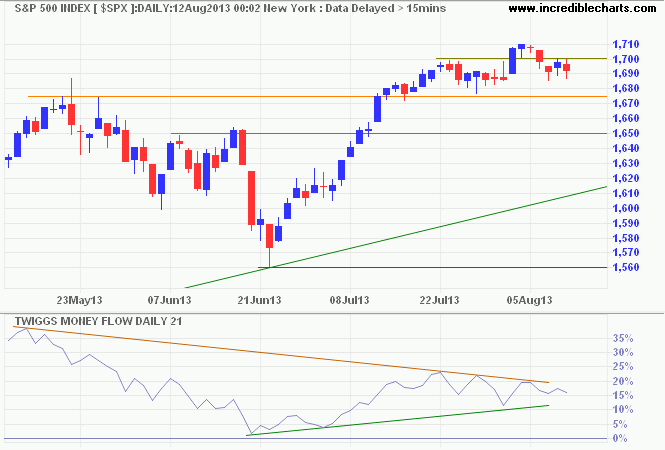
Sydney, Aug.12, free stocks .- The S&P 500 is again testing resistance at 1700 after a short retracement. Bearish divergence on 21-day Twiggs Money Flow continues to warn of selling pressure, but breakout above 1700 would signal an advance to 1800*. Reversal below 1675 would test support at 1650.
S&P 500
* Target calculation: 1680 + ( 1680 - 1560 ) = 1800
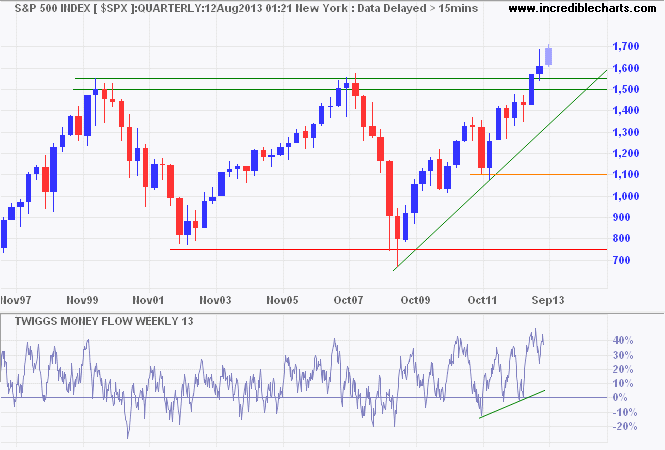
But the primary up-trend shown on the quarterly chart is healthy and, while correction to the rising trendline would be reasonable, trend reversal is unlikely.
S&P 500
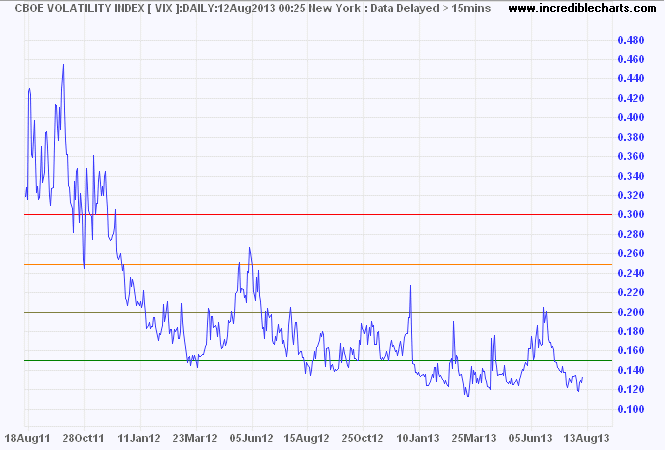
The VIX below 15 indicates low market risk.
VIX Index
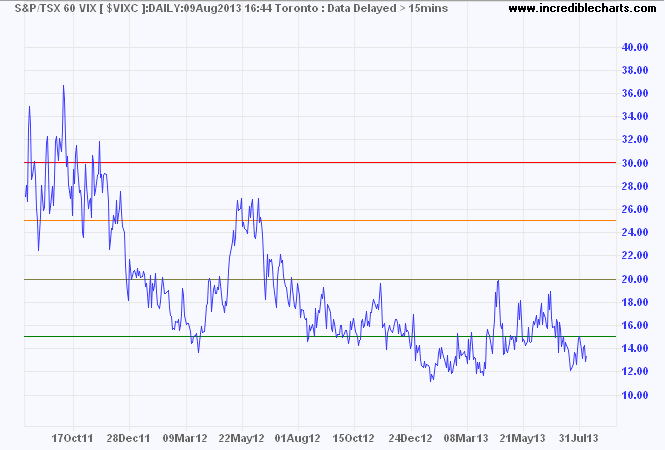
Canada's TSX 60 VIX is similarly bullish.
TSX 60 VIX
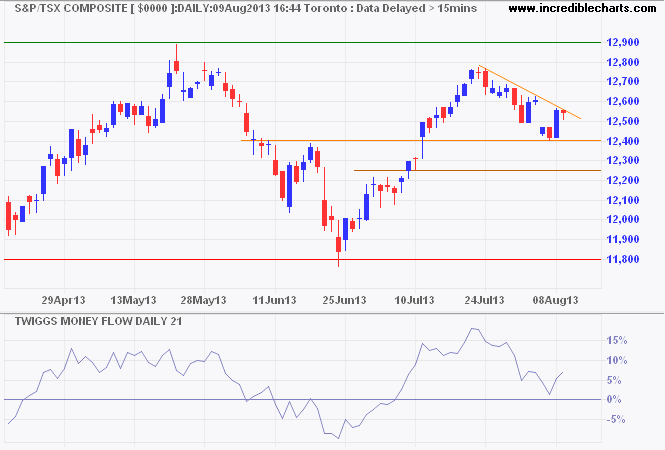
The TSX Composite Index is testing support at 12400. Penetration of the declining trendline would indicate the correction is over and advance to 12900/13000 likely. A 21-day Twiggs Money Flow trough above zero would suggest a healthy up-trend. Breach of support remains as likely, however, and would test 12250. In the long-term, breakout above 12900/13000 would offer a long-term target of 14000*.
TSX Composite Index
* Target calculation: 13000 + ( 13000 - 12000 ) = 14000 ...
Enhanced by Zemanta

How to define risk in dividend paying stocks?

The Coca-Cola logo is an example of a widely-r...
The Coca-Cola logo is an example of a widely-recognized trademark representing a global brand. (Photo credit: Wikipedia)
By Valueinvestingnews

Boston, Aug.12, free stock tips .- For many equity investors these days, risk is usually defined as an unfavorable fluctuation in stock prices. This means that an investor who purchased Coca-Cola (KO) at $40/share, and observes the price decline to $30/share, had a $10 unfavorable move in the price against them. This view on risk could be adequate for investors whose investing timeframe is in days or months. The problem with defining risk with stock market volatility however, does not make much sense for long-term investors.

As a long-term investor, I focus on identifying companies with strong fundamentals, and good business prospects, which I then try to accumulate at attractive valuations. I then monitor long-term business trends, read annual reports, and check to see if the company is earning more and paying out more in dividends. As a result, the data points I use are in “years”, rather than days or months. If you expect to hold a company for 20 years, focusing on a decrease from $40 to $30 is relatively immaterial. In my investing, I usually avoid focusing on price fluctuations, except as a tool to uncover cheap stocks to buy. Of course, if this drop is because of some material information that could affect the long-term prospects of the business, you need to evaluate whether you want to add or liquidate your position. However, if this drop is because stock prices are simply going down in tandem, chances are that you are not getting much from this information.

For me, risk is defined as a situation where I lose my all of investment capital. When I lose my investment capital, I would be unable to make more investments and earn more money from it. This permanent loss of capital is usually associated with situations such as business failure from the company I invested in. This would mean that not only would I lose out on a portion of my dividend income, but would also be unable to replace it because the capital base has dwindled significantly. This is why it is important to diversify my investments, in order to reduce the impact on my capital base from the effects of one company failing. If the stock I own merely goes from $40 to $30, but the fundamentals are unchanged I would not see that as a risk, but rather as the cost of doing business. Therefore, deteriorating fundamentals are a much larger risk to your capital and dividends than stock price fluctuations alone.

I believe that prices are what you pay, but value is what you get. Over the next 20 - 30 years that you hold dividend paying stocks, you will likely suffer big declines in stock prices on several occasions. This could be due to a lot of factors like recessions, wars, oil shocks, as well as a lot of company specific factors. The goal is to start with the facts first, such as a news release or an annual report for example, rather than focus on prices alone, and avoid making decision on rumors and opinions which are not grounded by facts. It is also important to be mentally prepared for declines in prices, and not panic and do something stupid like selling everything.

I would consider selling only after a dividend cut, in order to avoid acting on noise. The reason behind this rule is two-fold. The first reason is that companies do not grow to the sky in a straight-line. There are roadblocks along the way. At the time these roadblocks occur, it is very difficult to evaluate if they will result in a permanent loss or not. When Johnson & Johnson (JNJ) had issues in one of its subsidiaries in 2010, many investors feared the worst. Since then however, the company has managed to clean up operations, and succeeded. If you had sold back then, you would have missed out on the opportunity. As a result, any negative news might be scary at the time, but in the grand scheme of things, could be simply considered noise. This is why I note these negative events, but might refrain from selling off my position. I have also sold when I found valuation to be too high, but I have had mixed results from this scenario.

Second, in my analysis of companies, I have noted that when a company cuts dividends after it has paid and increased them for decades, it is usually admitting trouble. However, there is more trouble ahead, because boards typically make their decisions on whether to increase or cut distributions based on the business prospects for the next 2 – 3 years. In the Johnson & Johnson case above, the company was experiencing some issues, however they kept raising the dividend and kept earning more per share. This indicated that the problems are not as huge as expected.

Of course, selling after a dividend cut is not effective 100% of the time. However, it is a fail-safe mechanism, that can allow an investor to have a reasonable confidence that selling at this event will leave them with some capital. This capital can then be deployed in other attractive opportunities that will generate rising streams of income. In addition, selling after a cut removes any guesswork of whether the negative events you are learning about the company are noise or not. It should also be a wake-up call for the investor who “falls in love” with a company, and could expect to rationalize themselves out of selling a company with deteriorating fundamentals.

In conclusion, I define risk in dividend investing as an event that leads to total destruction of capital, from which my dividend income would be reduces or eliminated. In order to reduce this risk, I am diversifying my portfolio, and have a hard sell rule of disposing of a stock after a dividend cut. This would protect my dividend income, and allow me to enjoy the fruits of my labor in my golden years.

...
Enhanced by Zemanta