"No man can become rich without himself enriching others"
Andrew Carnegie


Showing posts with label online stock trading. Show all posts

Tuesday, August 27, 2013

YouTube Boob Tube for the Taper Solution

Kicking Television
Kicking Television (Photo credit: dhammza)
By Daily Reckoning

Washington, Aug.27, online stock trading .- There are big bucks on the boob tube. When I was a kid, one of my mother's most common chastisements was to turn off the TV and go do something else. In her mind, anything was better than sitting relentlessly in front of the boob tube watching inane programs.

Well, it seems Ma was wrong. Not only did my retinas not burn out from staring at the TV, but I've managed to make over 128% so far this year by simply keeping an eye on it. I'd like to highlight some television companies that may be worthy of your investment dollars--especially if you're looking for a play that won't be affected by the Fed's taper talk.

Because despite what you may have heard, television is far from dead. On any given day, some 2.2 trillion hours of television are being watched across the United States, according to Nielsen.
More surprisingly, people watch television over 4.6 times longer than they surf the Web, according to recent data from New Media TrendWatch.

So it boggles my mind that so many stock-picking gurus have been touting Web companies with questionable revenue streams. Consider Facebook, which has barely made it back to its IPO price. In fact, more than 54% of the Web company stocks tracked by the Dow Jones Internet index have lost money or trailed the S&P 500.

Meanwhile, we've been quietly racking up gains with what's really making money in the modern media age.

Simply put, it pays to advertise. Almost all media live and die by advertising revenue. And advertisers have a very good reason to continue throwing their money at television stations -- nothing else can match their scope.

Television has the reach of nearly 89% of the total U.S. population. Radio offers only a scant 58.8% reach. Newspapers fall to a mere 36.1% of the nation. (No wonder The New York Times and Washington Post both dumped newspaper assets.)

The only thing that comes close to matching television's reach is the Internet -- currently hitting 73.1% of the population. Good, but nowhere near the total reach of television.

And advertisers know that not only do they reach more folks through television, but also they get more action. Advertising industry studies show that nearly 40% of consumers first learn of brands that they buy from TV ads, compared with only 8.7% from Internet ads.

Furthermore, 37.2% of people cite television ads when making purchasing decisions, against a paltry 5.6% who cite Internet ads.

This all points to the obvious -- that television controls the vast majority of ad spending. It now makes up 54% of all U.S. ad spending… up from 52% just a few years ago.

But there's even more good news on the television ad market. Local television websites continue to draw in new viewers, and ad dollars have followed. Local online advertising revenues nationwide are up over 175.19% over the past five years -- 1.3 times higher than the overall growth of Internet advertising spending.

Of course, audiences aren't the only thing about television that's growing. Televisions themselves have gotten huge. Decades ago, a 25-inch screen was a big deal. Today, you'll find screens reaching 40, 50, 60 and 80 inches… and even bigger. (Most of them built with technology from another favorite company of mine, Samsung Electronics. But that's a story for another issue.)

But the same concept of bigger is better is what's happening for television station companies as well. They're expanding into markets around their home regions and nationwide.

There are some key reasons for this. First, as noted above, television dominates media attention and spending. So the more stations you own, the better.

Second, expanding regionally helps lower costs. If you have news reporters in each locality, you can have fewer covering larger-scale events.

Also, when it comes time to buy content for your television stations, the more eyeballs you can reach, the better the deals you can cut with distributors.

Increasingly, the bigger television companies with more market controls are even getting national networks to pay them to put their content out on local broadcasts. And the same goes for cable and satellite providers. They know all too well that folks demand local news and content, as well as network broadcasts that all have to flow through or from local television companies.

Third, there's been a major shift in the way television is broadcast -- and it's continuing to evolve, setting up another major growth area for television broadcast companies.

Back in 2009, the U.S. government mandated a switch from analog television broadcasting to digital.

But with the newer digital broadcasting standards, broadcast television companies discovered they were using less spectrum than they were allotted. So now companies are using that excess spectrum to roll out additional channels that are even more tailored to specific viewer groups.

This sets up whole new revenue streams that advertisers and content providers are eager to work with, resulting in more cash for broadcasters.

And it gets even better. Wireless data for smartphones and tablets demand more and more bandwidth -- and companies like Dish Network and even the U.S. government want to buy, or at least contract to use, some of the excess spectrum broadcasters are sitting on.

This means that broadcast companies are sitting on an increasingly valuable additional asset.


1.3 times higher advertising spending than overall growth in Internet spending? Groovy.

Armed with all of this good news, leaders in local television are scrambling to buy more local stations and other broadcast companies.

Deals are now coming at a fast pace. Tribune has upped its television companies by 100%, to 42 nationwide. Its latest deal bought out 19 stations from privately held Local TV Holdings. And Gannett is in the process of expanding its station count to 43, with the additional 20 coming from its deal to absorb Belo.

For Lifetime Income Report readers, I've picked out three specific broadcasting companies -- with market caps of a billion dollars or less -- that make for very tempting new targets for speculative investors.

...
Enhanced by Zemanta

Thursday, August 22, 2013

The Bear Market Isn’t Here Yet, But…

New York Stock Exchange
New York Stock Exchange (Photo credit: Mike_fleming)
Resistance will prove tough to overcome and risk is incredibly high


Bonds fell in reaction to the notes, as did stocks, mainly because the injection of cash into the financial system appears to have had only a small impact on jobs growth.
The report said, “Nonetheless, the unemployment rate remained elevated, and the continuing low readings on the participation rate and the employment-to-population ratio, together with a high incidence of workers being employed part time for economic reasons, were generally seen as indicating that overall labor market conditions remained weak.”
At Wednesday’s close, the Dow Jones Industrial Average was off 105 points at 14,898, the S&P 500 fell 10 points to 1,643, and the Nasdaq lost 14 points at 3,600. The NYSE traded 657 million shares and the Nasdaq crossed 359 million. Decliners outpaced advancers on the NYSE by 2.8- to-1 and on the Nasdaq by 2.1-to-1.
Chart Key
The New York Stock Exchange Composite Index contains generally higher-quality stocks. But like the other higher-quality indices, the Dow 30 and the S&P 500, it too has failed to find support at the crucial 50-day moving average mark. Its next support is at the intermediate support line at around 9,200. MACD is on a sell signal.
The Dow Jones Industrial Average broke its 50-day moving average, as well as its intermediate support line five sessions ago. Wednesday’s late sell-off puts the index in line for a serious attack on the support line at 14,845, its breakout point in August. A failure to hold that line would put the 200-day moving average in its sight — and threaten the long-term bull market.
Conclusion: Technically, the better-quality stocks are facing a battery of resistance that should stymie short-term rallies. When each support line is broken, that line then becomes a resistance line — a place which has proven to be where sellers lurk. In addition, the overall configuration of the Dow is taking on the form of a broad topping process that would be complete with a close under 14,845.
In his recent Street Smart Report, Sy Harding referred to another excellent technician, Mark Hulbert, who sees three signs of a market top:
First, the S&P 500 is up 23% in the last 12 months. Most bull markets top at over 21%.
Next, one of the most striking patterns about the month leading to a top is that the “riskiest stocks far outperform conservative ones.” We’ve discussed that at length in this column.
Finally, he mentions Warren Buffett’s favorite measure of market valuation — market capitalization versus GDP. In July, it reached 118%. The last times it went over 100% were in 1999 and 2007.
I, like Sy, don’t believe that we are beginning a bear market, although as he puts it, “But the risk is as high as in 2000 and 2007.” Ouch!
Enhanced by Zemanta

Global selling pressure

By Colin Twiggs

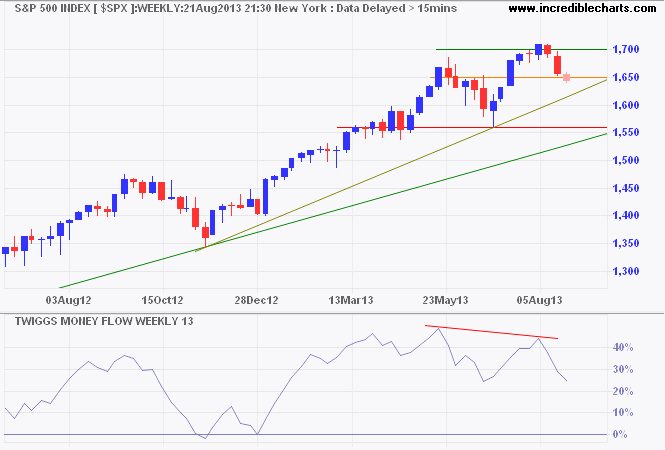
Sydney, Aug.22, investment opportunities .- The S&P 500 Index broke medium-term support at 1650 and is headed for a test of the rising trendline. Respect would indicate the primary up-trend is intact, but bearish divergence on 13-week Twiggs Money Flow warns of selling pressure. This is also evidenced by the marginal new high in August. A test of primary support at 1560 is likely. Breach would offer a target of 1400*.


S&P 500 Index
* Target calculation: 1550 - ( 1700 - 1550 ) = 1400
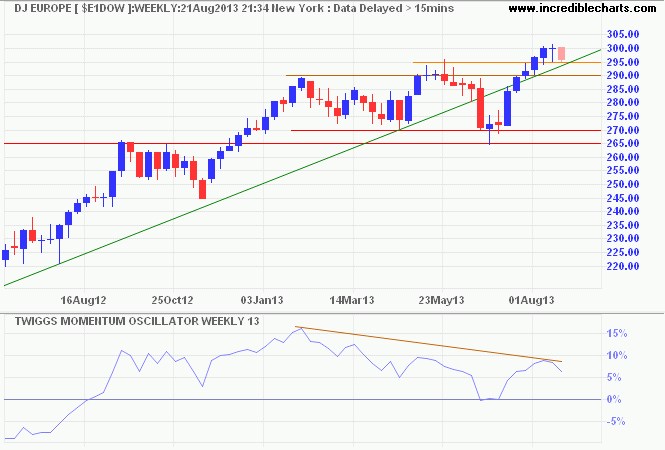
Dow Jones Europe Index also displays marginal new highs in May and August. Penetration of the rising trendline indicates the up-trend is losing momentum — also indicated by bearish divergence on 13-week Twiggs Momentum. Reversal below support at 290 would strengthen the warning, but only failure of support at 270 would signal a trend reversal.
Dow Jones Europe Index
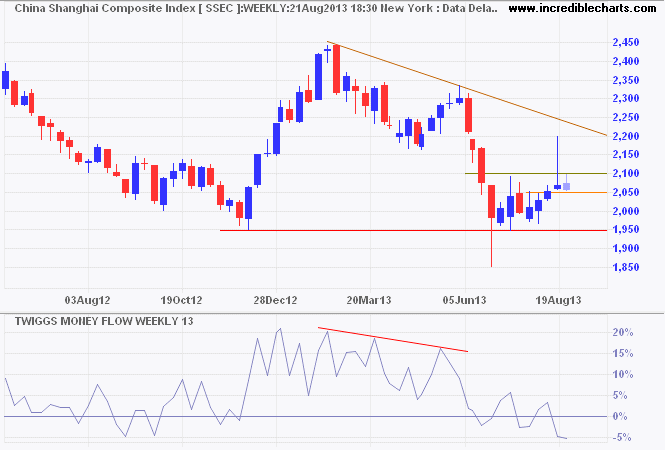
China's Shanghai Composite Index ran into strong resistance at 2100. Declining 13-week Twiggs Money Flow (below zero) warns of selling pressure. Reversal below 2050 would indicate another test of primary support at 1950, suggesting a decline to 1800*. Breakout above 2200 and the descending trendline is unlikely, but would signal that a bottom has formed.
Shanghai Composite Index
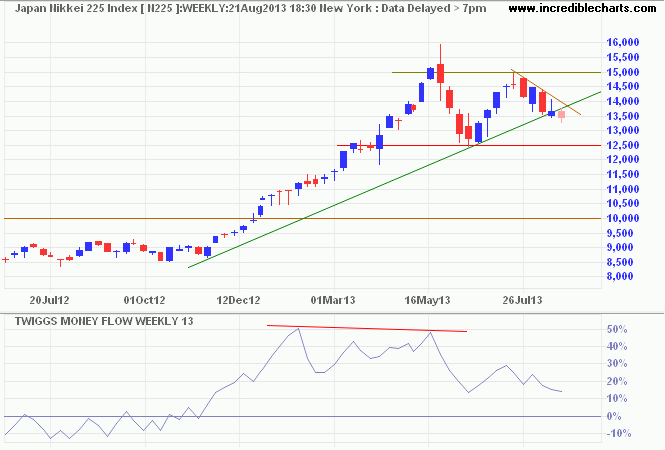
Japan's Nikkei 225 broke medium-term support at 13500. Follow-through below 13250 would indicate a correction to primary support at 12500. Penetration of the rising trendline suggests that the primary up-trend is losing momentum. Earlier bearish divergence on 13-week Twiggs Money Flow also warns of a reversal. Recovery above the declining trendline is less likely, but would indicate the correction has ended.
Nikkei 225 index
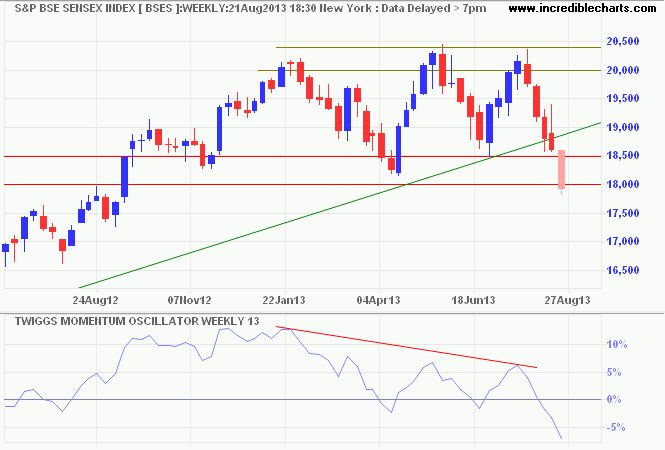
India's Sensex broke primary support at 18500, following through below 18000 to remove any doubt. The primary trend has reversed after a triple top and now offers a target of 16500*. Declining 13-week Twiggs Money Flow confirms selling pressure. Recovery above 18500 is unlikely, but would warn of a bear trap.
Sensex
* Target calculation: 18500 - ( 20500 - 18500 ) = 16500
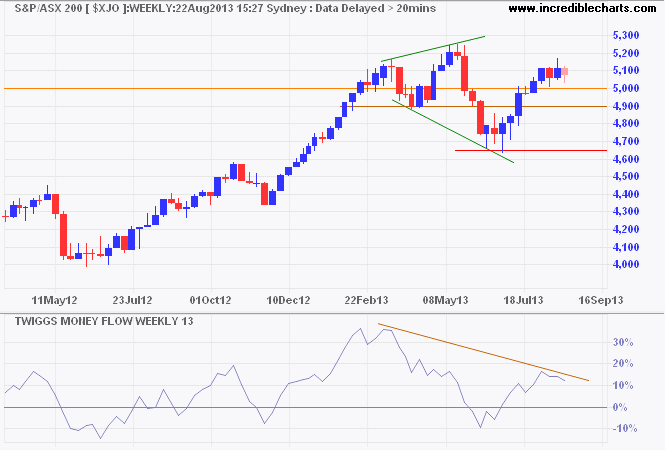
The ASX 200 is consolidating in a broadening top around the 2010/2011 high of 5000. Correction to 4900 would be quite acceptable, garnering support for an advance to the upper border, but breach of 4900 would indicate a failed swing, warning of reversal to a primary down-trend. Failure of primary support at 4650 would confirm. Bearish divergence on 13-week Twiggs Money Flow indicates selling pressure; strengthened if the indicator reverses below zero. Respect of support at 5000 is less likely, despite the long tail on today's candle, but would offer a target of 5300*.
ASX 200
* Target calculation: 5150 + ( 5150 - 5000 ) = 5300 ...
Enhanced by Zemanta

Tuesday, August 13, 2013

Gold Chart of The Week

By INO
Chicago, Agus.13, online stock trading .- Each Week Longleaftrading.com will be providing us a chart of the week as analyzed by a member of their team. We hope that you enjoy and learn from this new feature.
Weekly Gold Report August 12th through August 16th
Summer markets and light volume trading should continue to be the focus for the upcoming week. Despite the fact that the next five trading days have quite a bit of data to present, the reports are divided equally between the United States and Europe, along with a few from Japan and Great Britain. This mix of intermarket and intercontinental data should provide decent intraday volatility to trade, but I do not expect any fireworks.
The two standouts this week will be Retail Sales in the US and GDP reports from Germany, France and the Eurozone. Any one of these reports can provide some nice movement in the Currencies and Stock Indexes, but lighter volume trading should cap any major movement.
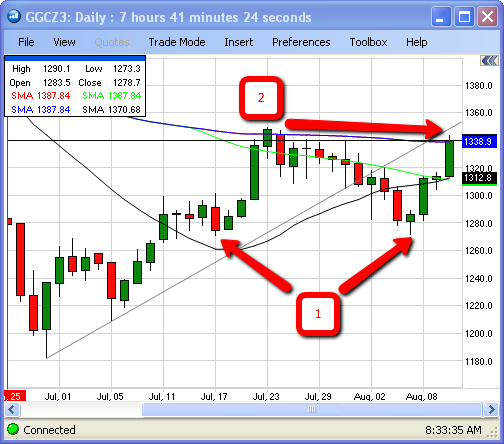
The Gold Futures have been a tricky market to predict from a fundamental perspective, which also makes a multi-day trade difficult. Over the last few years, Gold would look for things like a weak US Dollar or a weak Stock Market to provide a reason to rally or sell off. There was also the “Risk On-Risk Off” movement last year that provided the occasional curve ball. But lately it seems more impossible than ever to tie the direction of Gold to any one fundamental idea. But you CAN trust technical analysis.

The above chart is a daily of the December Gold Futures. Arrow #1 points out last weeks low that was a test of the prior chart consolidation from mid-July. A hold at this prior low provided a steady bounce that is now on its way to a test of a prior trendline that was supportive but now is seen as resistance. Not only is $1350 significant because of this trendline (identified by arrow #2), it is also significant because it is a retest of the July 23rd high print. An early climb off the open on Monday morning seems to me like a great way to bait traders into a long position before turning the market upside down. I will let the closing price of Gold today prove to me whether this idea is right or wrong.
Good luck this week and please feel free to reach out to me directly if you would like to discuss trading Gold Futures or any other Futures or Futures Options. I will be happy to hear from you.
.
Enhanced by Zemanta

Debunking the Myth of Free-Market American Health Care

singapore
singapore (Photo credit: Kenny Teo (zoompict))
By Daily Reckoning


Washington, Aug.13, national stock exchange .- Pascal-Emmanuel Gobry [a senior research analyst for Business Insider] posted a stimulating comparison between the American and French health-care systems. "From my outlook," he writes, "there's something that I haven't seen discussed and yet seems striking to me: how similar the French and U.S. healthcare systems are. On its face, this seems like a preposterous notion: whenever the two are mentioned together, it's to say that they're polar opposites."

Indeed, there are a lot of misconceptions about how America's health-care system compares to those of the other developed countries, including France. Both liberals and conservatives believe that the American system is a "free-market" or "capitalistic" one, and that European systems providing universal coverage are "socialized." In this article, I'll explain where both of these conceptions go wrong.

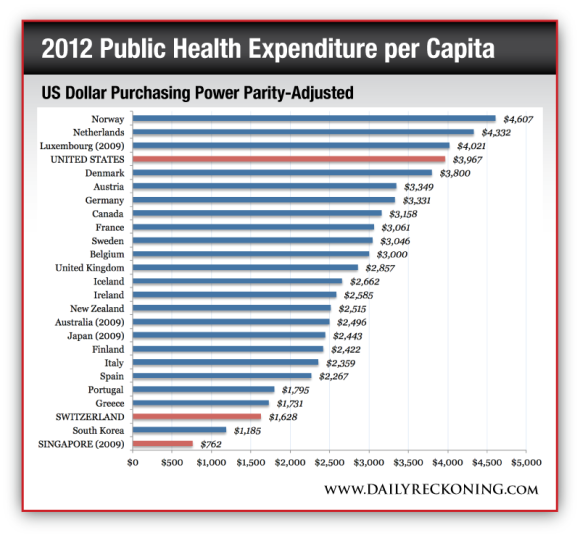
In reality, per-capita state-sponsored health expenditures in the United States are the fourth-highest in the world, only below Norway, Holland, and Luxembourg. And this is before our new health law kicks in:


In 2010, according to these statistics, which come mostly from the OECD, U.S. government entities spent $3,967 per person on health care, compared to $3,061 per person in France. Note that these stats are for government expenditures; they exclude private-sector health spending.

If anything, the U.S. figures understate government health spending, because they exclude the $300 billion a year we "spend" through the tax code by making the purchase of employer-sponsored health insurance tax-exempt.

So: if we measure the relative freedom of health-care systems by the dollar amount of government involvement in health spending, the French system is actually meaningfully freer than America's.

There are, of course, other important things to consider in terms of health-care freedom: do individuals have freedom to choose their own doctor, their own insurance, their own treatments, etc. On these bases, countries like the United Kingdom would fare very poorly. But very few people appreciate that the American government spends far more on health care than nearly every other country.

The thing to remember in America is that we have single-payer health care for the elderly and for the poor: the two costliest groups. In addition, the relatively healthy middle class has heavily-subsidized private health insurance, in which few individuals have the freedom to choose the insurance plan they receive. Neither of these facts commend the American health-care system to devotees of the free market.

One of the most frequently-made arguments in favor of socialized medicine is that it saves money, relative to the American system. And it is true that Europeans et al. spend less per-capita, and as a percentage of GDP, than we do.

But the pro-socialism argument has a glaring weakness: it ignores the two most significant examples of market-oriented universal coverage in the developed world, Switzerland and Singapore, where state health spending is far lower than it is in other industrialized nations. Neither Switzerland nor Singapore could be described as libertarian utopias -- both systems contain aspects that conservatives wouldn't like -- but they provide powerful examples of how market-oriented health care systems are more cost-efficient than socialized ones.

I've described Switzerland as having the world's best health-care system. In Switzerland, there are no government-run insurance plans, no "public options." Instead, the Swiss get subsidies, much like "premium support" proposals for Medicare reform or the PPACA exchanges, from which Swiss citizens buy health care from private insurers. The subsidies are scaled up or down based on income: poorer people get large subsidies; middle-income earners get small subsidies; upper-income earners get nothing.

The OECD puts Switzerland high on the league tables in terms of government health spending, but that is due to a statistical anomaly. Switzerland has an individual mandate; the OECD defines state health expenditures to include insurance premiums that the government requires individuals to pay, even if that spending is on private insurance. That is a debatable approach from the OECD, because the spending goes directly to the insurers, without the government as a redistributor. If you adjust for this anomaly, Swiss state health spending is $1,628 per person (which accounts for the taxpayer-financed premium support subsidies).

The premium support system allows the Swiss to shop for their own insurance plans, which gives them the opportunity to shop for value -- something that almost no Americans do. As a result, about half of the Swiss have consumer-driven health plans, combining high-deductible insurance with health savings accounts for routine expenditures.

The other important market-oriented counterexample is Singapore. Singapore has, arguably, the most market-oriented system in the world. Singapore's GDP per capita is about 20 percent higher than America's, with comparable (if not higher) health outcomes, and spends an absurdly low amount on health care relative to the West. How do they do it?

The key to the Singapore system is mandatory health savings accounts: again, something that libertarians and many conservatives wouldn't like. Matt Miller of the Center for American Progress describes Singapore as "further to the left and further to the right" than the American system -- something that could also be said of Switzerland.

In a manner somewhat like our Social Security system, Singapore takes mandatory deductions from workers' paychecks -- around 20 percent of wages -- and deposits them into health savings accounts called Medisave. Medisave accounts are used mostly for inpatient expenses, but also some outpatient ones. Singaporeans are expected to pay most of their outpatient expenses with non-Medisave cash.

On top of Medisave, Singapore has a government-run catastrophic insurance program called Medishield. Singaporeans can opt out of that plan and buy private catastrophic insurance. Premiums for Medishield can be paid for using the Medisave health savings accounts.

Then there is Medifund, a safety-net program for the bottom 10 percent of income earners, and Eldershield, a private insurance program for long-term care for those with old age-related disabilities. On top of these government-sponsored programs, Singaporeans can buy supplemental insurance for things like outpatient expenses.

Why does this system work so well? Because it incorporates the central idea behind free-market health care: that health-care spending is most efficient when that spending is executed by individual patients, rather than third parties. It's easy to waste other people's money. But if that money is your own, you are going to try your best to spend it wisely.

Singapore installed this system relatively recently. Prior to 1984, the former British colony had a system quite similar to that of Britain's National Health Service. In that year, the government reversed course, with impressive results. Singapore, of course, isn't a democracy -- which allows the government to install sweeping changes that wouldn't be realistic here. (And in no way should my praise of Singapore's health-care system be interpreted as an endorsement of the country's political system.)

The Swiss and Singaporean models wouldn't be perfect fits for America; we would want to replace the Swiss individual mandate, for example, with a more market-oriented approach like allowing people to opt out of buying health insurance if they also agree to forego subsidized care. But they both embody the most important principle of all: shifting control of health dollars from governments to individuals.

How could something like this come about in the United States? One could imagine a scenario in which Medicare was converted into the premium-support model, such as one of the Paul Ryan plans, with far more aggressive means-testing such that upper-income seniors would no longer be eligible for the program. In addition, the tax exclusion for employer-sponsored health insurance is phased out. The resultant savings could be used to offer subsidized private insurance to lower-income individuals, as a replacement for Medicaid. Obamacare's exchanges, though seriously flawed in their implementation, have some similarities to this approach. As these programs converge, we could have something that starts to look a lot like Switzerland.

The Singaporean system dovetails with an idea put forth by John Goodman and others: of a universal tax credit that Americans could use to buy health insurance, or possibly even Medisave-like HSAs.

My message to conservatives is: wake up. America's health care system has many qualities, but it is far more socialized than you think, and we can learn from the experience of other countries to make it better. My message to liberals is: if universal coverage is your goal, the possibility for bipartisan compromise exists, if you're open to considering market-oriented approaches like those in Switzerland and Singapore. Let's put our heads together.

.
Enhanced by Zemanta

How to Safely Catch a Falling Knife

Difference Between Stocks and Bonds
Difference Between Stocks and Bonds (Photo credit: Philip Taylor PT)
By Wealthy Retirement

New York, Aug.13, investment opportunities .- Despite the five-year run-up in the market there is a way to get great bargains by playing the beaten-up industries – i.e. bottom-fishing. And there is a technique that can allow you to do it without the usual risks associated with trying to catch falling knives…
Today I'm going to share a great example of how to use the technique to earn a reliable double-digit yield, but first let me explain why most bottom-fishing strategies fall short…
Knowing when a bargain will stop becoming an even better bargain is almost impossible to predict. Wall Street's paved with the blood of those who thought they could – and learned the hard way they could not.
That's why the only investors who typically venture into bottom-fishing for cheap stocks are:
  • Novices who don't know any better, or…
  • The very experienced who periodically get a little too full of themselves and forget the costly lessons the market has taught them.
But there is a way to benefit from bottom-fishing without all the risks of the "falling knife syndrome." Using it successfully requires stretching the envelope a little, but the rewards can be huge.
And, this strategy eliminates almost all the high-risk aspects of bargain hunting. It can be a big income producer and generate great capital gains, as well.
Three Reasons Cheap Bonds Are Better
Despite what most people think, bonds – all bonds – fluctuate in value. In fact, if an industry is getting hit particularly hard, corporate bonds, on a percentage basis, can drop in value almost as much as some stocks.
But there are several differences that make cheap bonds a much safer and more predictable way to play the bottom…
The first is the fact that no matter how low a bond's price drops, or how much it drops after you buy it, it continues to pay its interest. The coupon, which is cast in stone when the bond is issued, is cranked out every six months no matter what happens to the market price of the bond.
For instance, a 7% coupon will pay $70 a year in two equal payments, until maturity, whether the price goes up or down. And, unlike dividend stocks, the interest is paid to the bondholder from the time he takes possession.
So, the first big hurdle in bargain hunting is avoided; with bonds you make money all the way to maturity, from day one, no matter what the price does.
The next big difference between stock and bond bottom-fishing is no matter what you pay for a bond, at maturity, you get $1,000 for it. And yes, this is cast in stone, too.
Imagine being able to buy a stock at a 15% or 25% discount and know that in a set amount of time you will be paid the preset price of $1,000 for it. It seems almost too good to be true, but that is exactly what bonds offer.
The third big advantage of cheap bonds is that you know, before you invest one penny, exactly when and how much you will earn in interest and capital gains. There is no guesswork!
The interest and principal are paid on preset dates and, short of a default, which in this market is less than a 2% risk, nothing will change that.
AK Steel: A Beaten-Down Bargain
Here's a bond in a very beaten-up industry, steel, that will pay a big capital gain at maturity, a huge interest rate for this market, and you will know before you invest one dime how much your total return will be and exactly when you will receive every penny.
AK Steel has a bond (CUSIP - 001546AL4) with a coupon of 7.625% that we can buy now for about 86.2, or $862 per bond. At maturity in May 2020 we will receive $1,000 per bond in principal, $138 in capital gains, and will have collected 15 interest payments for a total of $571 per bond. That's a total return of $709 per bond, plus your principal.
On an income basis, $571 in interest equals a current yield of 8.84% per year. Current yield is based on our discounted purchase price of $862. It is calculated by dividing the coupon, 7.625%, by our cost, $862; 7.625 \ 862 = 8.84%.
Here's how the total return breaks down…
We have 15 interest payments of $38.12 every May and November until maturity, capital gains of $138 per bond at maturity, for a holding period of just under seven years, at a cost of $862 per bond, for an average annual return of 11.91%:
(15 x 38.12 + 132 / 82 / 862 x 12 = 11.91%)
The steel industry has been hit hard by the slowdown in China. The EU hasn't helped and the United States' own slow recovery has added to the drag, but the future looks very bright for AKS.
It's expected to move from a loss in 2013 of $0.50 per share to a profit of $0.31. That is a huge move in just one year!
Maybe more impressive are its five-year growth numbers. The industry is expected to grow at about 3.91%... But in the same period, AKS is looking at a 53% growth factor.
But, one of the best parts about bottom-fishing for bonds is, even if AKS doesn't hit these high numbers, even if it misses by a little – or a lot – it doesn't matter.
Unlike stocks, bonds are not dependent on the whims or the changing winds on Wall Street, or even quarter-to-quarter swings based on earnings.
As long as AKS is able to pay its bills when this bond matures (which with a 53% five-year growth estimate seems like a slam dunk), we will be paid every dime of our interest and capital gains. Even if stock and bond prices continue to drop, we still get paid.
That's how you bottom-fish. With cheap bonds you can…
  • Make money from day one.
  • Exceed the long-term return of the stock market by almost four points.
  • Know when and how much you will earn before you invest.
Bonds can reshape your entire investing life. They offer predictability, reliability, above-average annual returns and none of the risks associated with falling knives.
Take a look at cheap bonds.
...
Enhanced by Zemanta

Wednesday, August 7, 2013

A Stock Below $5 You Can Hold 'Forever'

Image representing Apple as depicted in CrunchBase
Image via CrunchBase
By StreetAuthority

New York, Agus.7, online stock trading .- It really shouldn't matter a lick what price a stock is trading at. There is no fundamental difference between a stock with 1 million shares trading at $50 and a stock with 10 million shares trading at $5.

Then again, there are people whose interest is piqued when they see a low price tag. It's one of the reasons why many companies will split their stock. The lower price tag will sometimes entice more buying.

When you consider the rule of large numbers, the phenomenon of lower-priced stocks rising faster than their higher-priced brethren does make a little sense. After all, for a stock trading at $5 to gain 50%, it has to only rise $2.50. But for a $100 stock, the same move takes $50.

Investors aren't always rational, and that $2.50 move seems a lot smaller than a $50 rise, even though they are the exact same in percentage terms.

With this in mind, I wanted share one of my growth stocks to buy and hold forever that's trading for less than $5...

But first, remember that I look for a very specific kind of company. As I've explained recently, by allocating just 20% of your portfolio to the "Next Big Thing," you increase your chances of making a lot of money in the stock market.

And I'll be honest, there's really no secret formula to finding game-changing stocks. The bulk of it comes down to a lot of research and making bold calls on where a company or technology will be a year, five years, or a decade down the line.

The thing is that no matter how much research goes into an idea, there is never any guarantee it will be a winner. If anyone -- even Warren Buffett -- says they can guarantee you a certain profit in the market, you should run away... fast.

I know not every idea can be a huge success. That's OK. But that doesn't stop me from looking for the handful of potential winners that could soar hundreds or thousands of percent like Netflix (Nasdaq: NLFX) or Apple (Nasdaq: AAPL) did.

And where have I found some of the highest-scoring winners? Oddly enough, it's been in stocks with low price tags.

A Toll-booth Operator For The Underground Energy Revolution
As prices at the pump start to inch higher -- and that's happening -- there's little doubt the nation will again begin to look at alternative fuels. There was some hope that electric vehicles like the Chevy Volt would help. The trouble is, no one's buying these cars despite heavy government incentives. So with electric vehicles out, the real question is what's in.

That means answering one question: How can we get cheaper gasoline?

The answer is biofuel.

The federal government has been interested in how it can wean the nation off petroleum which the U.S. must import. Of course, the shale boom is helping out with this problem, but that's just part of the equation.

The best solution for an alternative, so far, has been ethanol. The pure alcohol derived from the starch in corn that can be blended with gas, reducing the amount of petroleum the country needs to use.

Now, federal support of corn-based ethanol has waned. But another type of ethanol, made from a different part of corn or another plant entirely, is still very much in play.

A key step toward the meaningful use of biofuels dates back to the George W. Bush era, when a bill passed that codified a federal biofuel production quota into law. It calls for a range of biofuel, not only corn-based ethanol but also sugar-based fuel that the feds call "advanced biofuel." This is code for cellulosic ethanol, which is comes from a type of sugar that's found in all plant life.

This sugar is hard to get to. For much of recorded history, only animals, notably cows, have been able to get energy from this type of sugar, which is locked tightly in the cell walls of plants.

But now, using specially designed enzymes, producers can "tease" out the sugar, ferment it into ethanol and make biofuel from agricultural waste like wheat straw or corn stovers, from special grasses or even scrap wood and paper.

The companies in this space have been much maligned. For years, cellulosic ethanol and the idea of growing our fuel has been dismissed as pie-in-the-sky dreaming. But the science has caught up, lawmakers have embraced it -- and now a lot of major oil companies are bowing to the inevitable future of biofuel.

Lucky for us, there are a plenty of game-changing companies in the space, and a few have prices under $5 per share. My favorite is Dyadic International (OTC: DYAI).

Dyadic is a leader in the special proteins that refiners introduce to get the sugar-to-ethanol process going. The company makes the enzymes that tease out the sugar contained in all plant life -- without its products, all you have is a pile of worthless mulch.

Dyadic's business model is simple but elegant. It doesn't grow plants. It doesn't build $300 million refineries. It simply sells the enzymes to the cellulosic ethanol producers and receives a royalty for each gallon produced. Dyadic is a toll bridge operator. And every gallon of cellulosic ethanol that leaves its customers' factories has to pay the toll.

That's also why I call it one of the best growth stocks to hold forever. Forever is a long time, but I'm confident that as time passes, Dyadic's products will develop and new markets will emerge, and this little company will collect a royalty on more things than we can count.

Of course, with a stock that focuses on an unproven technology like biofuels, there a lot of risks involved that could lead to a fall in share price.

But by following my 20% Rule with stocks like Dyadic, you will limit that risk and potentially move the needle on your portfolio.
...
Enhanced by Zemanta

Monday, August 5, 2013

The Bull Is Confirmed — This Market Looks Very Strong

NASDAQ building
NASDAQ building (Photo credit: niallkennedy)
Even a soft jobs number can't keep this rally down


The big headline number, the unemployment rate, fell to 7.4% from 7.6%. But the labor participation rate fell to 63.4% from June’s 63.5%, which shows that a number of workers have dropped from the labor force. This capitulation has caused much of the decline in the unemployment rate. Payroll growth fell and the average workweek dropped to 34.4 hours from 34.5. Wages fell 0.3%.
At the close the DJIA was up 30 points to 15,658, the S&P 500rose 3 to 1710, and Nasdaq gained 14 to close at 3690. The NYSE traded 681 million shares and Nasdaq crossed 361 million. Advancers edged decliners on the Big Board by 1.1-to-1, and on Nasdaq decliners were ahead by 1.1-to-1.
For the week, the DJIA rose 0.6%, the S&P 500 gained 1.1%, and Nasdaq was up 2.1%.
Chart KeyOur trusty long-term chart of the S&P 500 with its 17-month moving average shows no sign of weakness and is a strong confirmation that the long-term bull market is not only intact but has gained momentum. Note how the index jumped from a slight correction after topping the highs of 2000 and 2007 as buyers hopped on the profit-taking.
08042013 collins djt confirm
Click to Enlarge
The Dow Transports rallied to a new high, confirming the previous high made by the DJIA. This is further confirmation of a powerful bull market — a new Dow Theory buy signal.
Conclusion: Despite what appears to be sluggish buying, the broad market is acting well, with wide participation and a confirming new Dow buy signal. I’d like to see both volume and breadth pick up a bit, but the major indices are in uncharted territory — the only thing that appears to be holding back stocks from another jump is a steady stream of profit-taking and a reluctance by the small investor to make a big commitment in stocks. As long as the little guy is timid, the institutions will continue to walk the market higher.
The threat of a terrorist attack will probably add to small investors’ fear, causing them to remain cautious. Our strategy is to hold for more gains and buy into any weakness.
Many thanks to Serge Berger for his superb market analysis during my absence. I believe Serge is one of the best technicians in our business. Now, if someone could only help me unpack the hundreds of boxes in my garage!
..
Enhanced by Zemanta

S&P 500 follows through, gold falls

English: Target sponsored IndyCar visiting Pur...
English: Target sponsored IndyCar visiting Purdue University on Toyota Day. (Photo credit: Wikipedia)
By Colin Twiggs

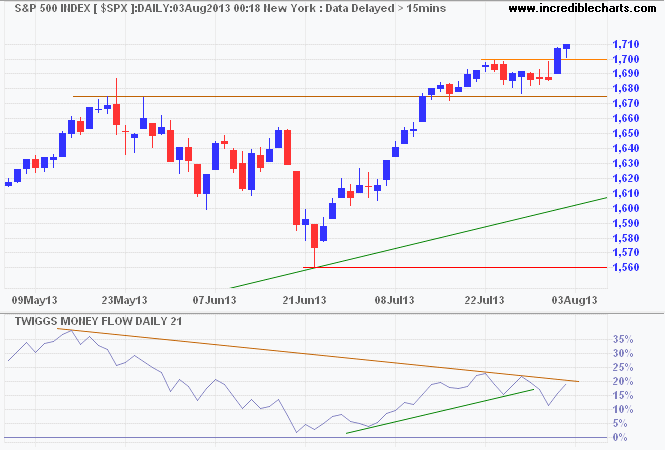
Sydney, Aug.5, investment opportunities .- The S&P 500 followed through above resistance at 1700, indicating an advance to 1800*. Bearish divergence on 21-day Twiggs Money Flow suggests selling pressure, but this is not as pronounced on the weekly chart and a peak above the May high would negate this. Reversal below support at 1675 remains unlikely, but would warn of another test of primary support at 1560.


S&P 500
* Target calculation: 1680 + ( 1680 - 1560 ) = 1800
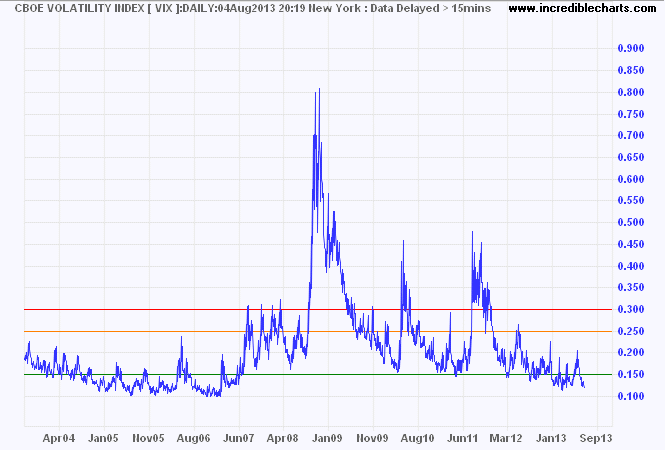
The VIX below 15 indicates historically low market risk.
VIX Index
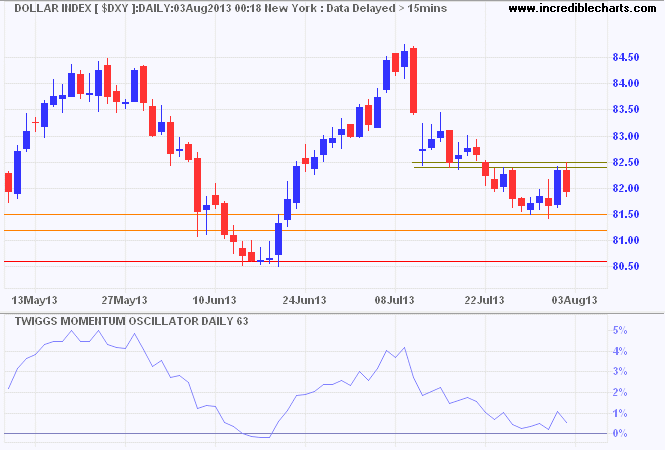
The Dollar Index is testing resistance at 82.50. Breakout would indicate the correction is over, suggesting an advance to 84.50. A 63-day Twiggs Momentum trough above zero would strengthen the signal.
Dollar Index
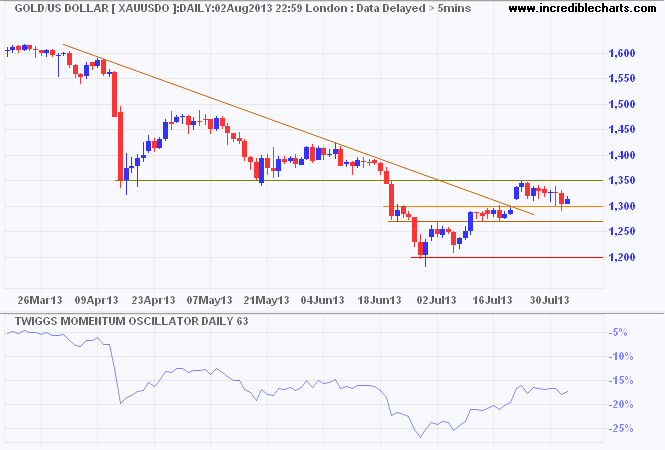
Gold continues to test support at $1300/ounce. Breach would suggest another test of primary support at $1200, while failure of primary support would offer a target of $1050*. Dollar Index breakout above 82.50 would strengthen the bear signal. Recovery above 1350 is less likely, but would indicate continuation of the rally to $1400/ounce.
Spot Gold
* Target calculation: 1200 - ( 1350 - 1200 ) = 1050
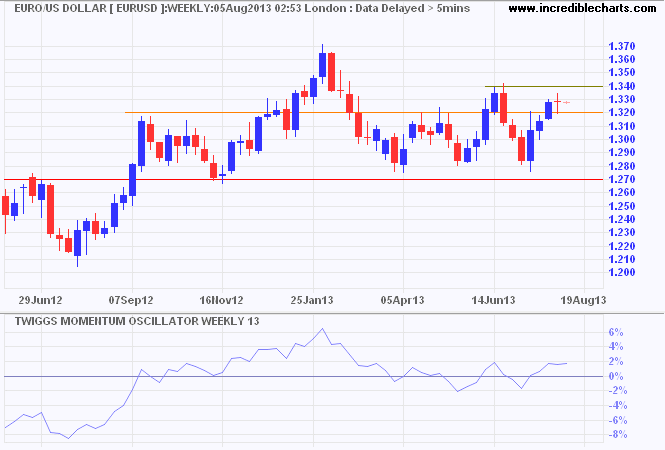
The Euro broke medium-term resistance at $1.32 and is testing the next level at $1.34. Breakout would indicate a primary advance, while respect of resistance (indicated by reversal below $1.32) would warn of another test of primary support at $1.27. Close oscillation of 13-week Twiggs Momentum around the zero line reflects hesitancy.
Euro/USD
* Target calculation: 1.34 + ( 1.34 - 1.28 ) = 1.40
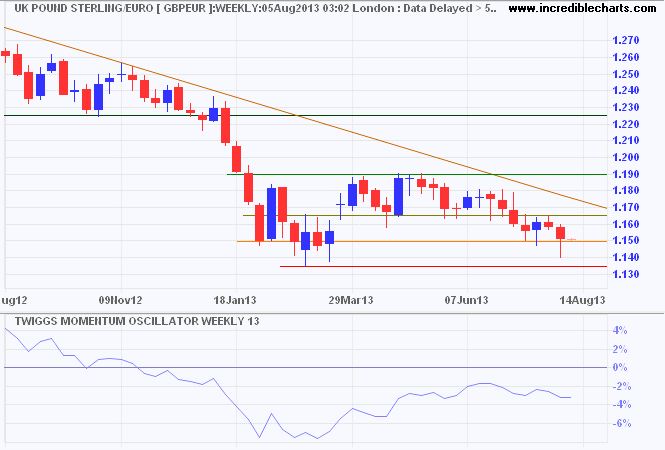
Sterling is testing primary support at €1.135 against the euro. Long tails indicate buying pressure and recovery above €1.165 would suggest that a bottom is forming. Breakout above €1.19 would complete a double bottom with a target of €1.24. Recovery of 13-week Twiggs Momentum above zero would strengthen the signal.
Pound Sterling/Euro
* Target calculation: 1.19 + ( 1.19 - 1.14 ) = 1.24
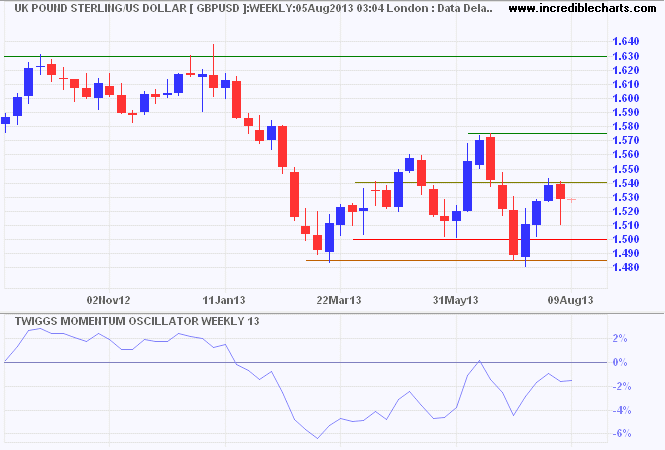
Against the greenback, Sterling is testing medium-term resistance at $1.54. Last week's long tail suggests buying pressure. Breakout would offer a target of $1.575. Respect is less likely, but would indicate another test of primary support at $1.485. Recovery of 13-week Twiggs Momentum above zero would strengthen the bull signal.
Pound Sterling/US Dollar ...
Enhanced by Zemanta